The NOVA framework was developed through research led by Dr Carlos Monteiro at the University of São Paulo and was incorporated into Brazil’s national dietary guidelines in 2014. The NOVA system classifies foods by the nature and purpose of industrial processing, from unprocessed or minimally processed foods to ultra-processed products. Its value is that it asks not only what nutrients a product contains, but also what has been done to the food.This matters because many modern metabolic problems are associated not only with individual nutrients, but with broader dietary patterns dominated by industrial formulations that are shelf-stable, rapidly consumed, often low in fibre and frequently high in added sugar. NOVA has been especially influential in Latin America and in global discussions about ultra-processed foods.Food Section Navigation
Foundations: Evolution and Diet • Genes and Food • Ancestral Foods • The Modern Diet • Western Diet and Environment • Sugar, Processing, and Policy: History of Sugar (Before 1984) • History of Sugar (After 1984) • Sugary Drinks • International Dietary Practices • USDA Dietary Guidelines • Glycemic and Starch Framework: Glycemic Index vs Load • Safe Starches • Dangerous Starches • Practical Food Pages: Root Crops • Legumes • Safe Nuts • Rice • Bread
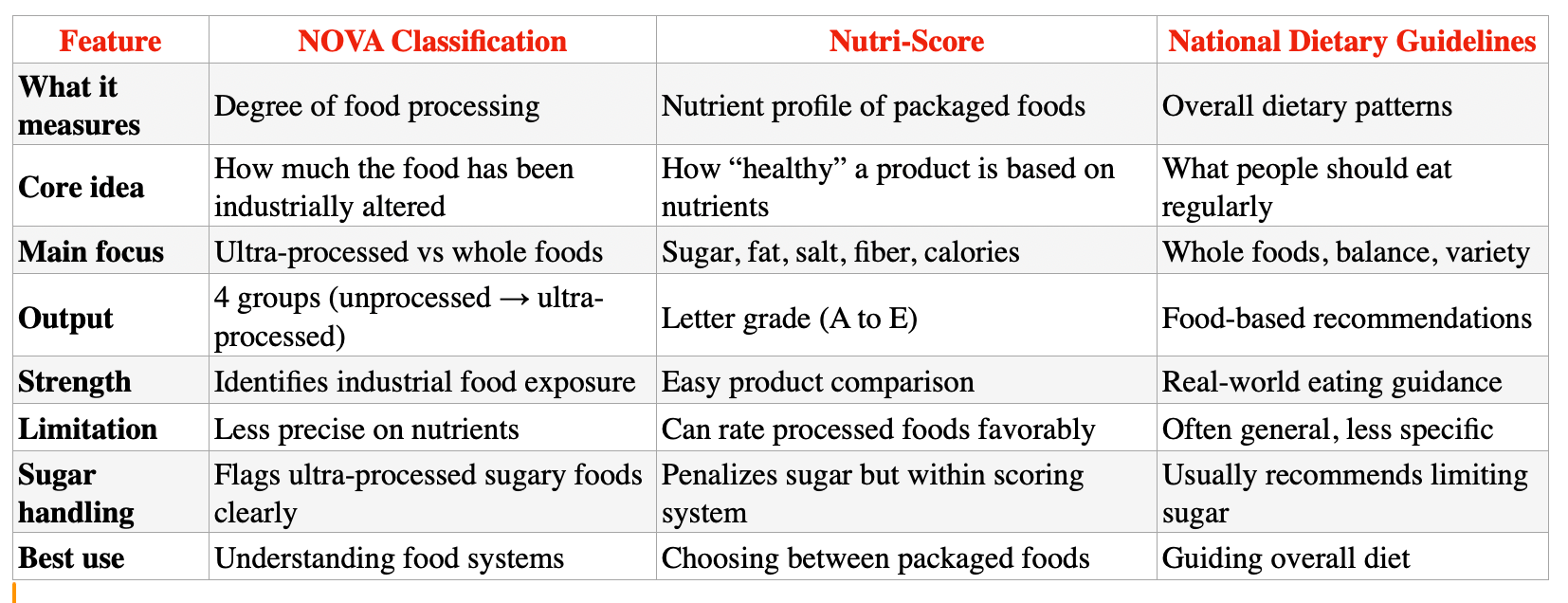
Key takeaways. NOVA classifies foods by the nature and purpose of processing; Nutri-Score summarizes selected nutrient characteristics; national dietary guidelines translate evidence into country-specific advice. These tools answer different questions and should not be treated as interchangeable diagnostic systems.
Different countries are trying different tools
Countries outside the United States are not relying on a single model to guide healthier eating. Instead, they are using a mix of approaches:
- food-based dietary guidelines
- front-of-pack labeling systems
- warnings about sugar, salt, and saturated fat
- growing attention to ultra-processed foods
National Guidelines (sample
Three frameworks are especially useful to compare:
- NOVA, which classifies foods by degree of processing
- Nutri-Score, which grades packaged foods by nutrient profile
- national dietary guidelines, which increasingly emphasize whole foods and lower intake of highly processed products
What NOVA does
The NOVA framework was the result of research by Dr Carlos Monteiro at the University of Sao Paulo, and rapidly adopted by the federal government of Brazil in 2014. The NOVA system classifies foods into groups based on how much industrial processing they have undergone, from unprocessed or minimally processed foods to ultra-processed products. Its main value is that it does not ask only, “How much sugar or fat is in this product?” It also asks, “What has been done to this food?”
This matters because many modern metabolic problems are linked not just to one nutrient, but to a broader dietary pattern built around products that are engineered, shelf-stable, rapidly consumed, and often low in fiber and high in added sugar. NOVA has been especially influential in Latin America and in global discussions about ultra-processed foods.
What Nutri-Score does
Nutri-Score is different. It is a front-of-pack nutrition label that gives foods a summary grade, usually from A to E, based on an algorithm that weighs favorable and unfavorable nutrient features. It is designed to help consumers compare packaged foods quickly. Under current EU rules, front-of-pack nutrition labeling is voluntary at the EU level, though individual countries have adopted or supported systems such as Nutri-Score.
Nutri-Score can be useful for comparing one processed product to another, but it is not the same as NOVA. A food can score relatively well on nutrients and still be industrially formulated. That is why the two systems should be seen as complementary rather than interchangeable. NOVA asks whether a food belongs to the ultra-processed world. Nutri-Score asks how its nutrient profile compares with competing packaged foods.
OpenFoodFacts.org
National Guidelines
Latin America: stronger attention to ultra-processed foods
Latin American public health work has been especially influential in shifting attention toward ultra-processed foods. PAHO has explicitly addressed ultra-processed products and linked them to obesity and noncommunicable disease, while NOVA itself has become central to regional and global discussions of diet quality.
This is one reason Latin America has often been ahead of North America in recognizing that the problem is not just “too many calories,” but the industrial restructuring of the food supply.
Canada: threshold warnings, not one national “traditional diet”
Canada offers a different model. Its food policy has to work across a highly diverse population rather than one single inherited dietary pattern. Canada now requires a front-of-package nutrition symbol on many prepackaged foods that meet or exceed set levels for saturated fat, sugars, or sodium. This is a warning-style approach rather than a single summary grade like Nutri-Score.
This matters because it directly highlights products with high sugar content, helping consumers identify foods that may worsen metabolic risk. In a country with many culinary traditions, the practical question becomes not “What is the one correct Canadian diet?” but “How do we help all Canadians recognize and reduce harmful processed food exposures?”
United Kingdom: clear free-sugar guidance
The United Kingdom has taken a relatively explicit position on sugar. The Scientific Advisory Committee on Nutrition recommended that free sugars should be reduced to no more than 5% of total energy intake. The rationale includes lower risk of excess calorie intake, obesity, and dental disease.
This is important because it gives sugar a clearly defined place in dietary policy, rather than treating it as a minor detail inside a broader discussion of calories.
Australia: food-based guidance with explicit sugar limits
Australia’s dietary guidelines are food-based and practical. They emphasize enjoying a variety of nutritious foods while also advising people to limit foods containing added sugars, saturated fat, salt, and alcohol. The Australian guideline specifically names discretionary foods such as biscuits, cakes, pastries, confectionery, sugar-sweetened soft drinks, and cordials.
This is not a NOVA-style system, but it does move in the same direction: it recognizes that many of the most harmful products are industrially produced, energy-dense, and nutritionally poor.
WHO and the broader international direction
The WHO has also pushed the conversation toward healthier food environments through work on front-of-pack labeling, nutrient profile models, and sugar guidance. These tools are designed to help countries identify products high in sugars, salt, and unhealthy fats, and to regulate the food environment more effectively.
Taken together, these international efforts point toward a broader consensus:
- highly processed foods matter
- liquid sugar matters
- front-of-pack clarity matters
- national guidance needs to address the modern food environment, not just abstract nutrients
Why this matters for metabolic disease
For a site focused on fructose, fatty liver, insulin resistance, and metabolic syndrome, these frameworks are important because they approach the same problem from different angles.
- NOVA identifies the industrial food pattern
- Nutri-Score helps compare packaged products
- national guidelines translate science into public advice
- OpenFood Facts is a free user friendly database App for retail shoppers
None is perfect on its own. But together they show that many countries are moving toward the same conclusion: diets built around whole or minimally processed foods are metabolically safer than diets dominated by industrial products, especially those high in added sugars.
Evidence, strengths and limitations
NOVA has made industrial food formulation visible in public-health research and policy. Diets high in ultra-processed foods are consistently associated with adverse outcomes, and controlled feeding research shows that an ultra-processed dietary pattern can increase energy intake under experimental conditions. Classification is not always straightforward, however. Studies have found disagreement when evaluators assign particular products to NOVA groups, especially when ingredient or manufacturing information is incomplete.
Processing and formulation should also be distinguished. Fermentation, freezing, pasteurization and canning can support safety and food access, while products formulated from refined starches, added sugars, fats, salt and additives may encourage overconsumption. A useful assessment therefore considers processing, formulation, nutrient profile, food structure, affordability and the role of the product in the whole diet.
Selected authoritative sources
- Monteiro CA et al. How and why ultra-processed foods harm human health.
- Braesco V et al. Ultra-processed foods: how functional is the NOVA system?
- Levine AS, Ubbink J. Ultra-processed foods: processing versus formulation.
- FAO: Food-based dietary guidelines—Brazil
Bottom line
The international trend is moving away from a narrow focus on single nutrients and toward a broader understanding of the food environment.
NOVA highlights the role of ultra-processed foods.
Nutri-Score helps consumers compare packaged products.
Countries such as Canada, the UK, and Australia are using policy and guideline tools to address sugars and poor-quality processed foods in different ways.
Continue Exploring
History of Sugar (pre-1984)
Industrial Fructose Era (Post-1984)
Guidelines from Other Countries
Ultra-Processed Foods and the Modern Diet
Metabolic Biochemistry
Different countries are trying different tools
Countries outside the United States are not relying on a single model to guide healthier eating. Instead, they are using a mix of approaches:
- food-based dietary guidelines
- front-of-pack labeling systems
- warnings about sugar, salt, and saturated fat
- growing attention to ultra-processed foods
National Guidelines (sample
Three frameworks are especially useful to compare:
- NOVA, which classifies foods by degree of processing
- Nutri-Score, which grades packaged foods by nutrient profile
- national dietary guidelines, which increasingly emphasize whole foods and lower intake of highly processed products
What NOVA does
The NOVA framework was developed through research led by Dr Carlos Monteiro at the University of São Paulo and was incorporated into Brazil’s national dietary guidelines in 2014. The NOVA system classifies foods by the nature and purpose of industrial processing, from unprocessed or minimally processed foods to ultra-processed products. Its value is that it asks not only what nutrients a product contains, but also what has been done to the food.This matters because many modern metabolic problems are associated not only with individual nutrients, but with broader dietary patterns dominated by industrial formulations that are shelf-stable, rapidly consumed, often low in fibre and frequently high in added sugar. NOVA has been especially influential in Latin America and in global discussions about ultra-processed foods.
This matters because many modern metabolic problems are associated not only with individual nutrients, but with broader dietary patterns dominated by industrial formulations that are shelf-stable, rapidly consumed, often low in fibre and frequently high in added sugar. NOVA has been especially influential in Latin America and in global discussions about ultra-processed foods.Food Section Navigation
Foundations: Evolution and Diet • Genes and Food • Ancestral Foods • The Modern Diet • Western Diet and Environment • Sugar, Processing, and Policy: History of Sugar (Before 1984) • History of Sugar (After 1984) • Sugary Drinks • International Dietary Practices • USDA Dietary Guidelines • Glycemic and Starch Framework: Glycemic Index vs Load • Safe Starches • Dangerous Starches • Practical Food Pages: Root Crops • Legumes • Safe Nuts • Rice • Bread
What Nutri-Score does
Nutri-Score is different. It is a front-of-pack nutrition label that gives foods a summary grade, usually from A to E, based on an algorithm that weighs favorable and unfavorable nutrient features. It is designed to help consumers compare packaged foods quickly. Under current EU rules, front-of-pack nutrition labeling is voluntary at the EU level, though individual countries have adopted or supported systems such as Nutri-Score.
Nutri-Score can be useful for comparing one processed product to another, but it is not the same as NOVA. A food can score relatively well on nutrients and still be industrially formulated. That is why the two systems should be seen as complementary rather than interchangeable. NOVA asks whether a food belongs to the ultra-processed world. Nutri-Score asks how its nutrient profile compares with competing packaged foods.
OpenFoodFacts.org
National Guidelines
Latin America: stronger attention to ultra-processed foods
Latin American public health work has been especially influential in shifting attention toward ultra-processed foods. PAHO has explicitly addressed ultra-processed products and linked them to obesity and noncommunicable disease, while NOVA itself has become central to regional and global discussions of diet quality.
This is one reason Latin America has often been ahead of North America in recognizing that the problem is not just “too many calories,” but the industrial restructuring of the food supply.
Canada: threshold warnings, not one national “traditional diet”
Canada offers a different model. Its food policy has to work across a highly diverse population rather than one single inherited dietary pattern. Canada now requires a front-of-package nutrition symbol on many prepackaged foods that meet or exceed set levels for saturated fat, sugars, or sodium. This is a warning-style approach rather than a single summary grade like Nutri-Score.
This matters because it directly highlights products with high sugar content, helping consumers identify foods that may worsen metabolic risk. In a country with many culinary traditions, the practical question becomes not “What is the one correct Canadian diet?” but “How do we help all Canadians recognize and reduce harmful processed food exposures?”
United Kingdom: clear free-sugar guidance
The United Kingdom has taken a relatively explicit position on sugar. The Scientific Advisory Committee on Nutrition recommended that free sugars should be reduced to no more than 5% of total energy intake. The rationale includes lower risk of excess calorie intake, obesity, and dental disease.
This is important because it gives sugar a clearly defined place in dietary policy, rather than treating it as a minor detail inside a broader discussion of calories.
Australia: food-based guidance with explicit sugar limits
Australia’s dietary guidelines are food-based and practical. They emphasize enjoying a variety of nutritious foods while also advising people to limit foods containing added sugars, saturated fat, salt, and alcohol. The Australian guideline specifically names discretionary foods such as biscuits, cakes, pastries, confectionery, sugar-sweetened soft drinks, and cordials.
This is not a NOVA-style system, but it does move in the same direction: it recognizes that many of the most harmful products are industrially produced, energy-dense, and nutritionally poor.
WHO and the broader international direction
The WHO has also pushed the conversation toward healthier food environments through work on front-of-pack labeling, nutrient profile models, and sugar guidance. These tools are designed to help countries identify products high in sugars, salt, and unhealthy fats, and to regulate the food environment more effectively.
Taken together, these international efforts point toward a broader consensus:
- highly processed foods matter
- liquid sugar matters
- front-of-pack clarity matters
- national guidance needs to address the modern food environment, not just abstract nutrients
Why this matters for metabolic disease
For a site focused on fructose, fatty liver, insulin resistance, and metabolic syndrome, these frameworks are important because they approach the same problem from different angles.
- NOVA identifies the industrial food pattern
- Nutri-Score helps compare packaged products
- national guidelines translate science into public advice
- OpenFood Facts is a free user friendly database App for retail shoppers
None is perfect on its own. But together they show that many countries are moving toward the same conclusion: diets built around whole or minimally processed foods are metabolically safer than diets dominated by industrial products, especially those high in added sugars.
Bottom line
The international trend is moving away from a narrow focus on single nutrients and toward a broader understanding of the food environment.
NOVA highlights the role of ultra-processed foods.
Nutri-Score helps consumers compare packaged products.
Countries such as Canada, the UK, and Australia are using policy and guideline tools to address sugars and poor-quality processed foods in different ways.
Related pages
History of Sugar (pre-1984)
Industrial Fructose Era (Post-1984)
Guidelines from Other Countries
Ultra-Processed Foods and the Modern Diet
Metabolic Biochemistry