Introduction
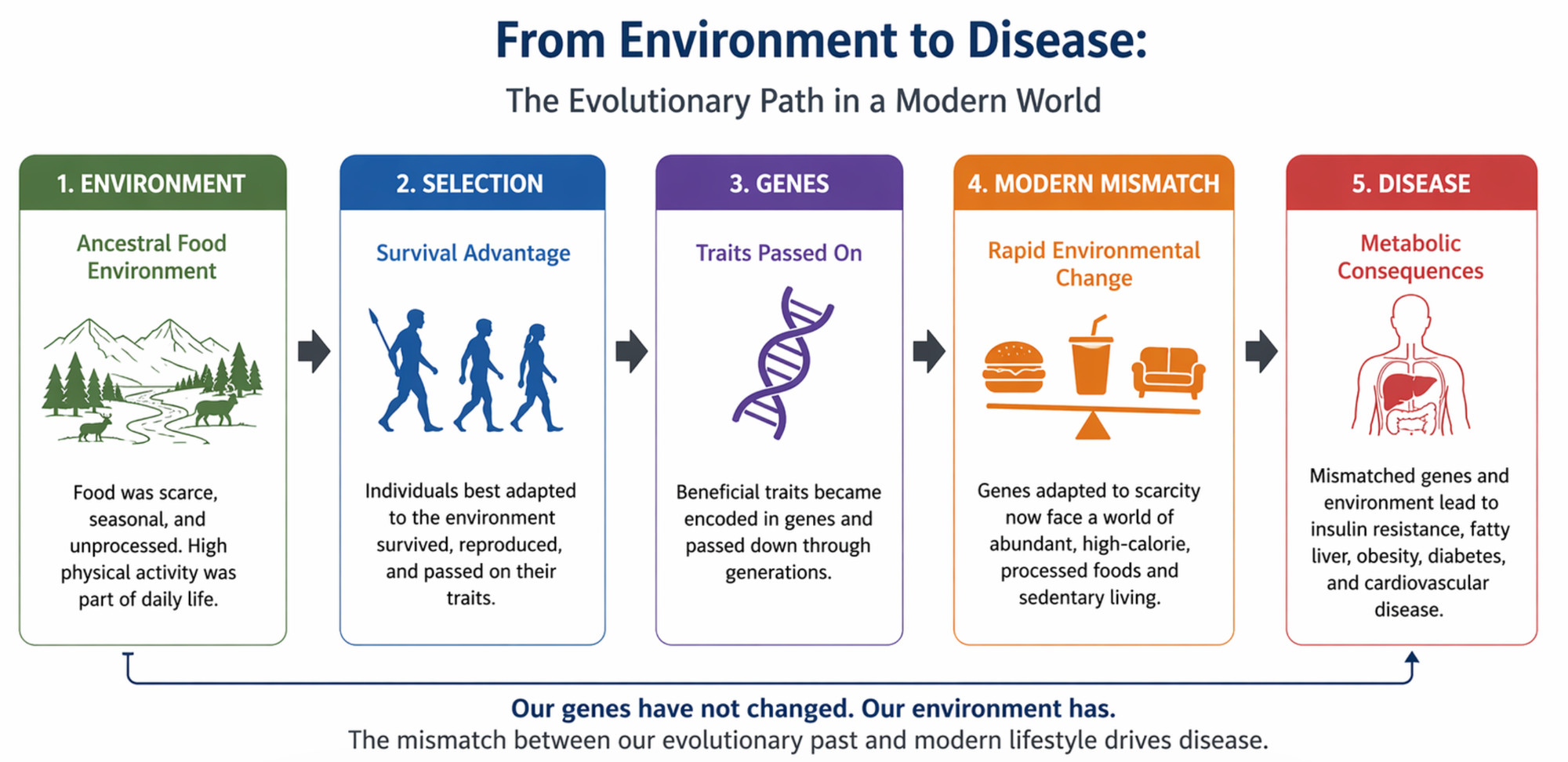
Human metabolism did not develop randomly.
It was shaped over thousands of years by:
- food availability
- climate
- geography
- patterns of scarcity and abundance
In each environment, individuals whose metabolism best matched the available food supply were more likely to survive and reproduce.
Over time, these traits became more common.
Food Environments Shape Human Metabolism
Survival and food environment
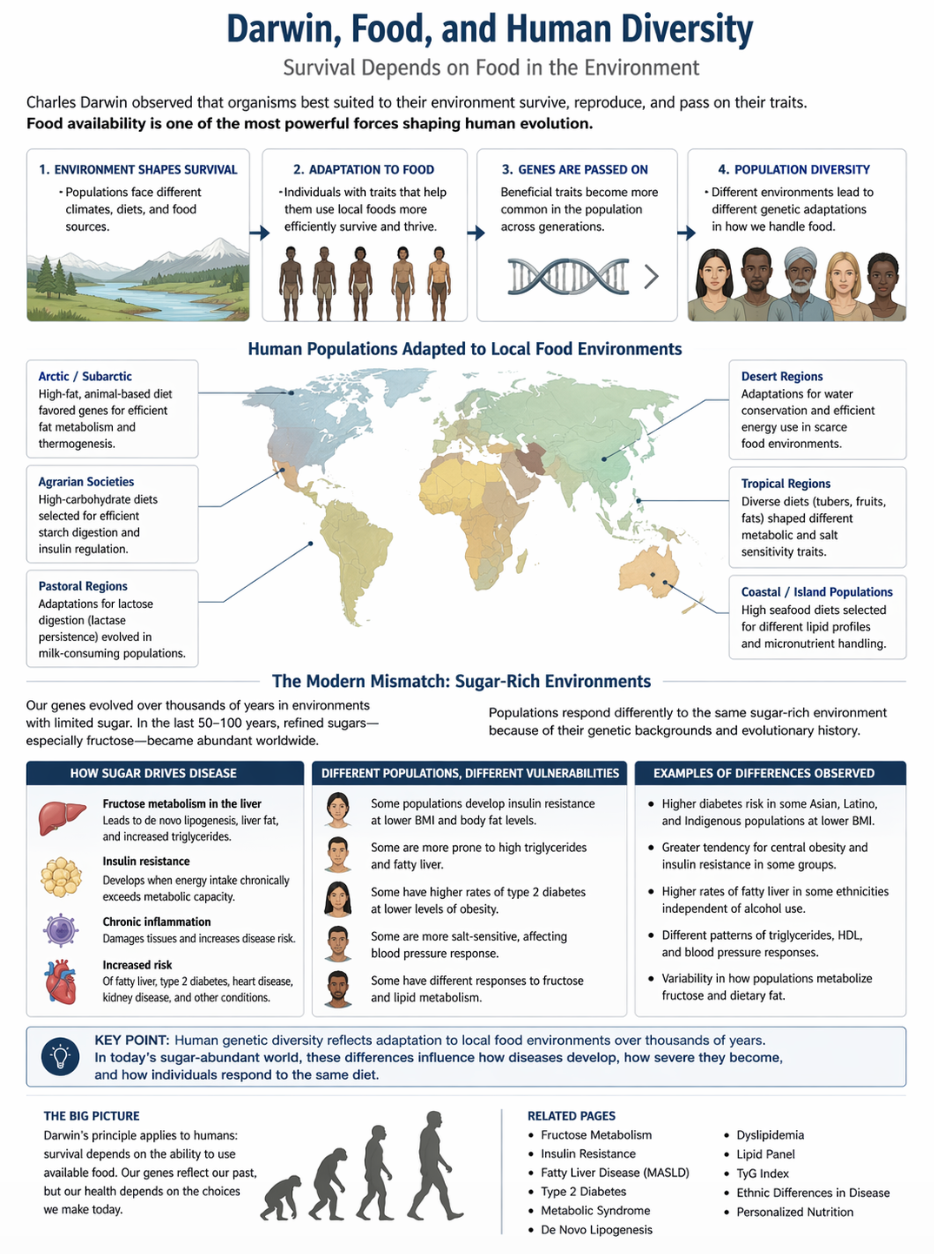
In any environment, survival depends on:
👉 access to food
👉 ability to use that food efficiently
When food is scarce or variable, the ability to:
- store energy
- conserve fuel
- rapidly convert food to fat
becomes advantageous.
When food is abundant, different traits may be favored.
Over generations, populations adapt to their local food environment.
Genetic adaptation to diet
Different populations developed different metabolic traits based on their ancestral diets.
Examples include:
- populations adapted to high-carbohydrate diets
- populations adapted to marine or high-fat diets
- populations adapted to seasonal or intermittent food supply
- populations adapted to root crops or grain-based diets
These adaptations influence:
- insulin sensitivity
- fat storage
- liver metabolism
- energy expenditure
The “thrifty” response
Many populations developed what is often described as a “thrifty” metabolic response.
This includes:
- efficient energy storage
- rapid fat production when food is available
- resistance to weight loss during scarcity
In traditional environments, this was protective.
It allowed survival through:
- famine
- seasonal variation
- unpredictable food supply
From adaptation to mismatch
The modern food environment is fundamentally different.
Instead of:
- intermittent intake
- limited sugar
- whole foods
we now have:
- constant food availability
- refined carbohydrates
- high sugar intake
- frequent eating
This creates a mismatch:
👉 metabolic systems adapted to scarcity are now exposed to continuous abundance
Fructose and the modern environment
One of the most important changes is the rise of sugar and fructose.
In ancestral diets:
- concentrated sugar was rare
- fructose exposure was limited and seasonal
In modern diets:
- sugar is widely available
- fructose intake is high
- exposure is frequent
Fructose is processed in the liver and promotes:
- fat production
- triglyceride elevation
- insulin resistance
👉 See: Fructose Metabolism
Why disease differs between populations
Because populations adapted differently, the impact of modern diets varies.
Some populations show:
- higher rates of obesity
- earlier onset diabetes
- more severe metabolic disease
Examples include:
- Pacific Island populations
- Indigenous North American populations
- some Middle Eastern populations
These differences reflect:
- genetic adaptation
- rate of dietary change
- degree of exposure to modern foods
A shared pathway, different outcomes
Despite these differences, the underlying process is the same:
modern diet
→ metabolic overload
→ insulin resistance
→ liver fat
→ metabolic disease
What differs is:
- how quickly it develops
- how severe it becomes
The global pattern
Across the world, the same pattern appears:
traditional diet
→ rapid food system change
→ increased sugar exposure
→ metabolic disease
Some populations are affected earlier and more severely, but the pathway is universal.
Why this matters
Understanding this helps explain:
- why the same diet affects people differently
- why some regions experience extreme disease
- why traditional diets were protective
- why modern diets create widespread problems
Bottom line
Human metabolism is adapted to past environments, not modern food systems.
Differences between populations reflect:
- long-term adaptation to specific diets
- rapid exposure to new food environments
The result is a mismatch between:
👉 biology shaped by scarcity
👉 and a world of constant, high-sugar food availability
Related pages
Fructose Metabolism
Global Metabolic Transition
Indigenous North America
Pacific Islands
Metabolic Syndrome
Food Subsection Navigation
Food • Evolution and Diet • Ancestral Foods • Modern Diet • NOVA and Ultra-Processed Foods • Sugar History • Sugary Drinks • Starches • Rice • Bread • Root Crops • Legumes • Nuts • Genes and Food • Dietary Guidelines
Key takeaways. Human diets have always been diverse and flexible. Some gene–diet adaptations—especially lactase persistence and variation in fatty-acid metabolism—are well supported, while broad claims that a population possesses a single “thrifty gene” remain hypotheses rather than settled explanations of obesity or diabetes.
Dietary Adaptation Is Gene–Culture Coevolution
Humans alter food environments through cooking, farming, fermentation, animal domestication and trade. These cultural practices can create biological selection pressures. Lactase persistence is a leading example: several genetic variants allow continued digestion of lactose in adulthood, and their geographic distribution reflects complex histories of pastoralism, migration and selection.
Starch Digestion and AMY1
The salivary amylase gene AMY1 varies in copy number. A landmark study reported higher average copy numbers in populations with traditionally starch-rich diets than in comparison populations with lower-starch diets. Copy number explains only part of salivary amylase variation, however, and it should not be used to assign an individual a diet from ancestry alone.
FADS and Fatty-Acid Metabolism
Variants in the FADS gene cluster influence conversion of shorter-chain fatty acids into long-chain polyunsaturated fatty acids. Population frequencies differ, and research supports historical dietary selection. Clinical translation remains incomplete: genetic associations do not yet justify simplistic population-wide prescriptions.
Why “Mismatch” Needs Qualification
The evolutionary mismatch model proposes that rapidly changing environments expose vulnerabilities shaped under earlier conditions. It is useful for understanding why constant access to energy-dense food may challenge systems that evolved amid variable food supply. But there was no single Paleolithic diet, and modern disease cannot be explained by genes alone. Social conditions, food marketing, sleep, activity, medicines and early-life exposures also matter.
Population Differences Without Stereotypes
Genetic variation occurs within every population, and ancestry categories are imperfect proxies for genotype. A population may show a different average risk while individuals overlap extensively. Respectful guidance begins with family history, clinical measurements, food culture and access—not assumptions based on appearance or nationality.
Implications for Precision Nutrition
- Use established clinical markers before speculative genetic narratives.
- Preserve culturally meaningful minimally processed foods.
- Consider validated genetic information when it changes care, but avoid deterministic claims.
- Distinguish evolutionary evidence from intervention evidence.
- Recognize that most metabolic traits are polygenic and strongly influenced by environment.
Selected Sources
- Yang S, Ye K. Adaptive evolution of metabolic genes and traits.
- Perry GH et al. Diet and the evolution of human amylase gene copy number variation.
- Ségurel L, Bon C. On the evolution of lactase persistence in humans.
- Turner BL, Thompson AL. Beyond the Paleolithic prescription.
- Internets: Genes and Food
Food Section Navigation
Foundations: Evolution and Diet • Genes and Food • Ancestral Foods • The Modern Diet • Western Diet and Environment • Sugar, Processing, and Policy: History of Sugar (Before 1984) • History of Sugar (After 1984) • Sugary Drinks • International Dietary Practices • USDA Dietary Guidelines • Glycemic and Starch Framework: Glycemic Index vs Load • Safe Starches • Dangerous Starches • Practical Food Pages: Root Crops • Legumes • Safe Nuts • Rice • Bread