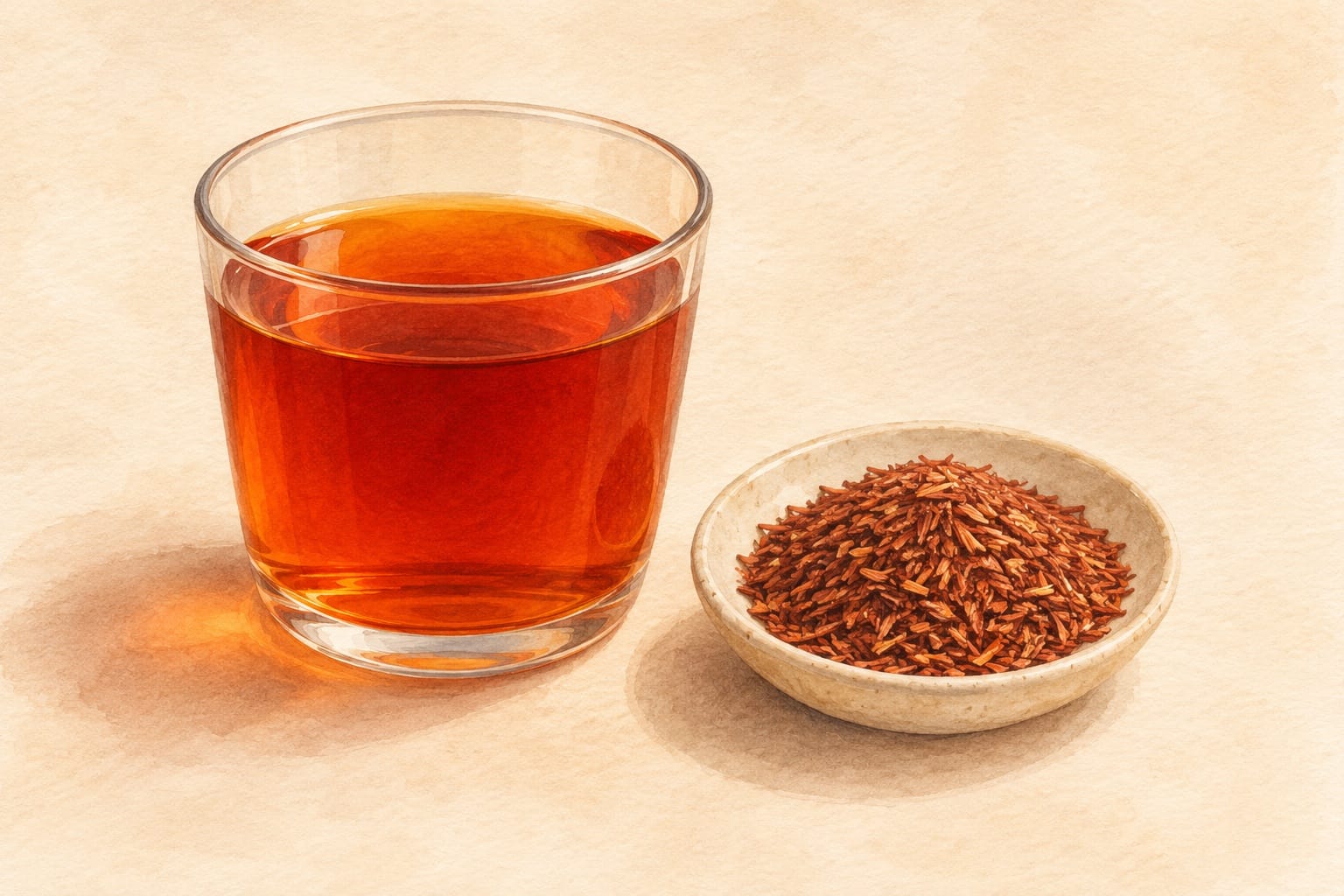
Heritage in a glass · South Africa
Rooibos brings a mellow, earthy flavour and an amber-red colour to the cup. Enjoyed plain, it offers a South African alternative for people who want a drink without added sugar or caffeine.
At a glance: Steep plain rooibos in freshly boiling water and serve without sugar. Credit the Khoikhoi and San knowledge associated with its heritage. Rooibos is a beverage, not a proven treatment, and people receiving cancer or transplant treatment should discuss regular use with their care team.
- Main ingredient
- Aspalathus linearis leaves and fine stems
- Added sugar
- 0 g in this plain recipe
- Caffeine
- Plain rooibos is naturally caffeine-free; check blends
- Important caution
- Discuss use during cancer or transplant treatment
Give the heritage its proper credit
Rooibos, Aspalathus linearis, is associated with South Africa’s Western Cape and Cederberg landscape. Its story includes indigenous knowledge, farming communities and the modern tea industry. The South African Rooibos Council describes the 2019 benefit-sharing agreement recognising Khoikhoi and San contributions. South African Rooibos Council: a South African living heritage.
Naming those communities is part of telling the story respectfully. We describe a living South African tradition rather than assigning an unsupported ancient date to the modern tea bag.
A rounded cup without caffeine
Plain rooibos is naturally caffeine-free. Its flavour can suggest sweetness even when no sugar has been added; flavour and measured sugar content are different things. Blends, ready-to-drink bottles and café preparations can contain other ingredients, so check the label. South African Rooibos Council: frequently asked questions.
Make a simple pot or pitcher
Makes: about 1 litre, or four 250 mL servings. Time: 5–7 minutes, plus chilling if desired.
- 4 plain rooibos tea bags intended for a cup each, or the equivalent quantity specified by the pack
- 1 litre drinking-quality water
- No sugar, honey, syrup, juice or sweetener
- Put the rooibos in a clean heat-safe pot. Bring the water to a full boil.
- Pour over the bags, cover, and steep for 5–7 minutes, or longer if the manufacturer requires it. Remove the bags.
- Serve after cooling to a comfortable drinking temperature, or cool promptly and refrigerate for iced rooibos.
Packet strengths differ; follow the product’s directions. This household suggestion draws on standard rooibos brewing guidance from Rooibos Limited: making the perfect cup, rather than claiming to reproduce a single ancestral recipe.
What the evidence does—and does not—show
Rooibos is often advertised with broad antioxidant or disease-prevention claims. Human research is limited, and a laboratory finding is not proof that a drink prevents or treats disease. Memorial Sloan Kettering discusses rare reports of liver injury and potential interactions, including a report involving tacrolimus and excessive consumption. People with liver disease, hormone-sensitive cancer, or cancer or transplant treatment should ask their care team before regular use. These reports do not establish how often harm occurs in ordinary drinkers. Memorial Sloan Kettering: rooibos tea, evidence and precautions.
Do not use concentrated extracts or supplements as substitutes for this beverage recipe. Pregnancy, breastfeeding and children require individual guidance rather than an assumption that caffeine-free means suitable for everyone.
Check the finished drink
The plain recipe adds no sugar, but we have not measured its total sugar content. Adding milk changes the nutrition; adding honey, syrup or sugar changes the added-sugar claim. A packaged “rooibos iced tea” may differ substantially from a plain home infusion.
Prepare, cool and serve with care
Use drinking-quality water, clean utensils and ingredients sold for food use. Prepare these infusions hot before chilling; follow the product’s brewing instructions. For herbal infusions, use freshly boiling water and steep for at least five minutes, or longer if the pack requires it. German Federal Institute for Risk Assessment: boiling water for herbal teas.
For a chilled pitcher, cool promptly in smaller heat-safe containers and refrigerate rather than leaving it warm on the counter. As a conservative household rule, refrigerate within two hours, or within one hour above 32°C / 90°F, and keep the refrigerator at 4°C / 40°F or below. These limits adapt general food-handling guidance; they are not a tested shelf life for these recipes. Make small batches, enjoy freshly prepared, and follow any shorter storage directions on the pack. FDA: safe food handling.
Explore the collection
Egypt & Sudan
Karkadé
Bright red · floral · tart
Hibiscus calyces. Read medicine and pregnancy cautions.
Heritage, recipe and safetyJapan
Mugicha
Toasted grain · nutty · mellow
Roasted barley. Contains gluten.
Heritage, recipe and safetySouth Africa
Rooibos
Amber red · rounded · earthy
Plain rooibos. Naturally caffeine-free.
Heritage, recipe and safetySources
- South African Rooibos Council: a South African living heritage
- South African Rooibos Council: frequently asked questions
- Rooibos Limited: making the perfect cup
- Memorial Sloan Kettering: rooibos tea, evidence and precautions
- German Federal Institute for Risk Assessment: boiling water for herbal teas
- FDA: safe food handling
- FDA: is food safe if it has chemicals?
Keeping ingredients in perspective
All drinks—including water, traditional teas and modern soft drinks—contain chemical substances. The word “chemical” alone does not tell us whether something is harmful. What matters is the substance, the amount consumed and the person drinking it. Modern soft drinks vary in their ingredients and sugar content; compare the actual product rather than assuming every soda is the same. Traditional drinks can offer flavour, cultural connection and options without added sugar, but their long history does not guarantee that every preparation suits everyone. FDA: is food safe if it has chemicals?.
Questions about this drink
What caffeine-free tea can I drink instead of soda?
Plain rooibos is a caffeine-free South African leaf-and-stem infusion. The preparation here adds no sugar, honey or syrup and offers a rounded flavour. It can be served as directed in the recipe; no added sugar does not establish a measured total-sugar value.
Does caffeine-free rooibos suit everyone?
No. Caffeine-free describes one property, not universal suitability. Read the individual precautions in this guide, particularly if receiving cancer or transplant treatment, and discuss regular use with your care team when appropriate.
Medical disclaimer
Educational resources only. Internets.com cannot provide personal medical advice, diagnosis, treatment recommendations, lab interpretation, or case review.
This information does not replace individual medical or dietary care. Consult a qualified health professional who knows your circumstances about medicines, allergies, pregnancy, breastfeeding, children, or existing illness. Do not stop or change prescribed treatment because of a beverage recipe.
Published 15 November 2026 · Internets Press. Recipes are editorial serving suggestions; no individual medical review is claimed.