Internets Press | Our Mission
A healthier marketplace makes better choices easier to see, easier to understand, and easier to buy.
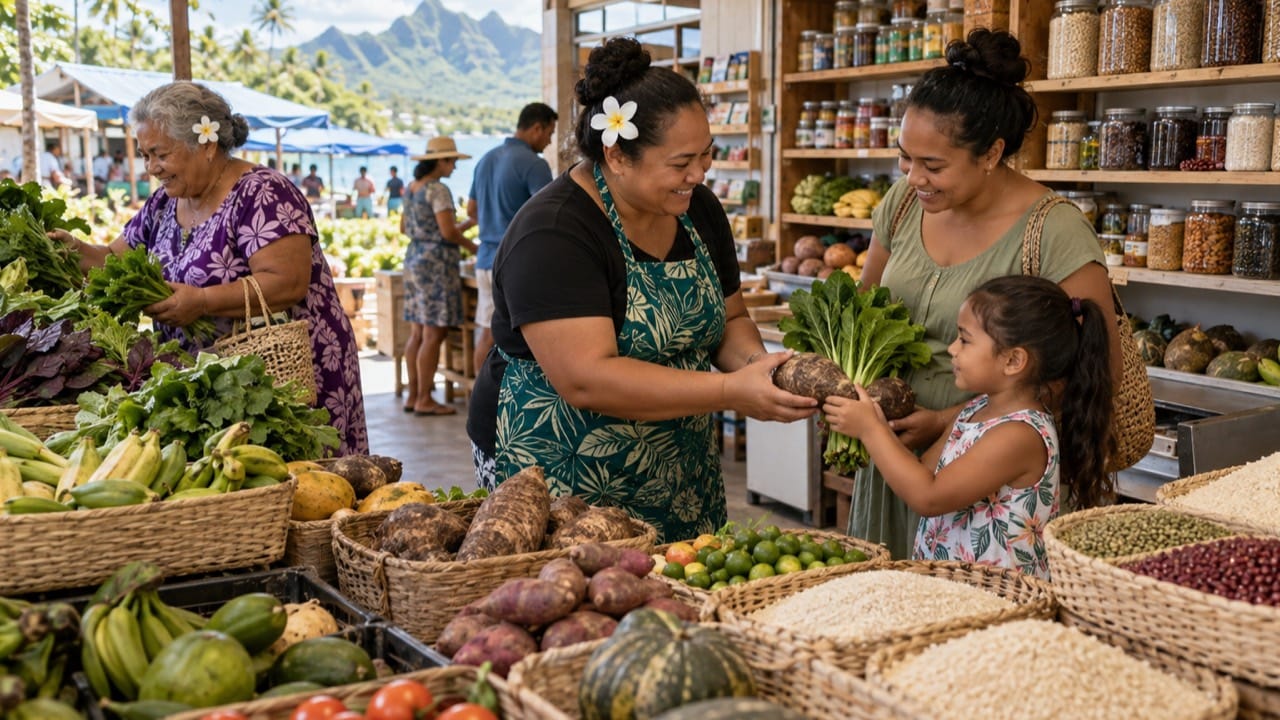
Our Mission · Food, culture and livelihoods
From Bread to Gardens: Growing a Local Food Economy
We can begin with one bakery and grow toward a community food economy: children learning the foods and stories of their families, farmers earning a living from fresh produce, and local buyers making those foods easier to find and afford.
Our proposal connects the Healthy Bakery Initiative with school learning gardens, commercial market gardens, and—where land, water, skills and demand support them—larger production of pineapples, coconuts, bananas and other locally suitable crops. Funding would help establish the practical connections between growers, families, schools and markets. This is a proposed development pathway, not a report of an operating or funded programme.
Bread is a beginning
A bakery gives the Mission a familiar place to start: a product people know, a business they can visit, and a recipe they can taste. It can also create a first commercial relationship with a local grower. The next step is to extend that relationship beyond ingredients for bread to vegetables, roots, legumes and whole fruits that families can prepare at home.
The ambition is simple: make food knowledge useful at the dinner table and make growing good food a viable livelihood. An educational event can introduce a crop; a regular order can help a farmer plan its production. Both are needed.
What we mean by microeconomics
Microeconomics concerns the choices and constraints facing households, workers and businesses. Here it means practical questions: Can a family afford the produce? Does the grower cover costs, including labour? Can a market sell the harvest before it spoils? Will a school or restaurant order again?
We propose a repeating relationship: children and families discover familiar foods; buyers place orders; farmers plan plantings; produce reaches local kitchens; and payments support the next growing cycle. That cycle must be tested. Local production does not automatically mean lower prices, dependable supply or a profit.
A useful farm budget records sales alongside seed or planting material, water, soil inputs, paid and family labour, packaging, transport, losses, maintenance and equipment costs. Grant income should be shown separately from trading income. The aim is to learn which activities can continue through sales and which educational or access benefits need continuing public or charitable support.
Fresh produce and NOVA Group 1
NOVA classifies foods by the extent and purpose of processing. Group 1 includes unprocessed or minimally processed foods. Fresh vegetables, roots, whole bananas, pineapple and coconut flesh fit this group; plain frozen produce can fit too. NOVA describes processing, not where a food was grown. Local origin and processing category should therefore be described separately. Source: Monteiro and colleagues on NOVA.
Simple bread made from flour, water, yeast and salt is generally Group 3, not Group 1; formulations with characteristic industrial ingredients can fall into Group 4. Coconut oil is a culinary ingredient in Group 2, distinct from coconut flesh. Making something locally does not change these classifications. Source: Brazilian Ministry of Health dietary guidelines.
Our fresh-produce programme would prioritise diverse Group 1 foods, while the bakery programme would assess the actual recipe, ingredients, taste, price and nutritional composition. An ancestral ingredient alone does not establish a food’s health benefit. Neither a NOVA category nor a local-food label replaces consideration of the overall diet and individual needs.
Children can grow pride alongside plants
Imagine a child learning a plant’s name in the language of a grandparent, hearing how it was grown or prepared, tending it in a learning garden, and explaining it at a community tasting. Pride in ancestry becomes something the child can practise and share.
We propose a simple sequence: ask an elder; record the story with permission; grow or visit the crop; prepare it safely with an adult; and share what was learned. Invite farmers and cooks to teach alongside elders. Include the traditions of all participating families and distinguish a crop’s botanical origin from the place it has acquired in local food culture.
School gardens should be manageable learning spaces. FAO’s school-garden guidance connects growing with food preparation and classroom learning. Commercial supply should come from adult growers; children’s participation is education, not a source of unpaid farm labour. Source: FAO school-garden manual.
A practical pathway from a small plot to a larger harvest
| Stage | What we would build | What must be demonstrated |
|---|---|---|
| 1. Bakery and learning garden | One willing bakery, a school or community learning plot, elder-led food stories and a small grower network. | A responsible coordinator, safe land and water, teacher capacity, grower interest and a maintenance plan. |
| 2. Market gardens | Adult-run plots supplying a manageable mix of vegetables, roots and seasonal fruits to households and local businesses. | Saleable harvests, realistic costs, repeat buyers, affordable options and reliable payment. |
| 3. Shared distribution | Coordinated orders, harvest schedules, reusable crates, suitable storage and collection or delivery routes. | Enough demand to justify shared costs, clear ownership, food-handling procedures and transparent accounts. |
| 4. Larger crop production | Locally assessed pineapple, coconut and banana enterprises alongside a diverse food supply. | Crop-specific agronomic advice, secure land and water, working capital through establishment, pest and storm planning, and credible buyers. |
Each crop needs its own business case. A small vegetable plot and a longer-term fruit planting cannot share an assumed harvest calendar or cash-flow forecast. Larger production should follow local trials and demand assessment. Expansion should preserve space for affordable local food rather than making export sales the only measure of success.
A Northern Marianas starting point
This proposal can build on existing local expertise. NMC-CREES has reported pineapple cultivation research and soil assessment work with the Division of Agriculture. These are relevant starting points for discussions about crop suitability and farm planning; they do not establish a partnership with Internets Press or validate a particular business plan. NMC-CREES pineapple research; local soil assessment work.
For pineapples, coconuts and bananas, the first investment decision should follow a site assessment and conversations with growers and buyers. Check planting material, land tenure, water availability, cultivation and harvest requirements, crop protection, transport and the time before sales begin. Use local quotations and advice before requesting a production budget.
Give growers a market they can plan for
Possible customers include households, market vendors, bakeries, restaurants and institutional kitchens. Schools may be an important partner where purchasing rules, budgets, menu needs and food-safety requirements allow. FAO’s home-grown school-feeding approach links school-food demand with local farmers and community businesses; it provides a useful model to examine locally. Source: FAO on inclusive procurement.
Before planting for a buyer, agree the crop, acceptable quality, likely quantities, delivery frequency, pricing method, substitutions and payment timing. Keep opportunities accessible to smaller growers. A school garden should complement this system through learning; it should not be expected to supply an entire meal programme.
Affordability belongs in the design. Track retail prices, offer practical quantities and accessible collection points, and consider transparently funded produce support for households that need it. Paying farmers fairly and helping families afford food are both programme objectives; any subsidy must have an identified funder and duration.
What government and NGO funding could make possible
- Start a viable pilot: coordination, land and water assessment, basic tools, planting material, grower training and paid setup work.
- Connect culture with learning: teacher preparation, elder and grower teaching time, accessible materials, supervised garden activities and community cooking sessions.
- Get the harvest to buyers: order coordination, handling equipment, appropriate storage and delivery arrangements sized to actual demand.
- Support fair access: clearly budgeted produce assistance, convenient collection and transparent farmer-payment arrangements.
- Learn before expanding: farm accounts, harvest and loss records, buyer feedback and an independent review of readiness for the next stage.
Government could help convene agriculture, education and public-health teams and clarify land, water and purchasing requirements. NGOs could organise participation, fund training and access, and help maintain transparent records. Farmers should shape production decisions and be paid for their work. Teachers and elders should shape the learning. Buyers should specify what they can realistically purchase.
No agency, NGO or buyer is represented here as a confirmed funder or partner. The invitation is to develop a locally costed pilot together.
Measure progress that matters
Before the pilot begins, agree a baseline and a small set of measures: participating growers; marketable kilograms harvested and sold by crop; spoilage as a share of harvested quantity; farmer revenue and costs; payment delays; repeat orders; household prices; and learning activities completed. Specify the reporting period and units, and record donated resources separately.
Children’s learning can be assessed through crop identification, food stories and practical skills without collecting body-weight or medical data. Participation and sales do not prove a reduction in diabetes or obesity. Any later health evaluation would need an appropriate design and oversight.
Begin with one community and a plan that can grow
We invite interested government teams, NGOs, growers, schools and local businesses to help define one demonstration community, one coordinating organisation and a realistic first growing cycle. The initial task is a shared plan: which foods, which land, which growers, which buyers, what costs and who is responsible.
Bread opens the door. Gardens bring food knowledge to life. A dependable local market can give that knowledge an economic future.
Continue with the Healthy Bakery Initiative and Our Mission.
Take the next step
Markets teach silently
Every store, restaurant, food stall, and checkout counter teaches. It teaches what is normal, what is convenient, what is promoted, and what is worth noticing. A community that wants better metabolic health must eventually look at the places where food decisions actually happen.
Visibility is a public health tool
Healthy choices do not help if nobody can find them. Traditional staples, unsweetened drinks, whole foods, minimally processed ingredients, healthier breads, and local produce should be visible. A small shelf sign, menu note, or market display can change what people notice first.
Do not make perfect the enemy of better
A healthier marketplace does not require every product to be ideal. It asks whether better options are present, affordable, labeled clearly, and promoted with dignity. The early goal is to give families a path toward improvement, not to create a purity test.
Local businesses can lead
Grocers, market vendors, restaurants, cafeterias, and bakeries can become allies. Community groups can recognize businesses that make practical changes. Schools can visit markets. Clinicians can point patients toward visible healthier options. The marketplace then becomes part of the educational environment.
What a community can do now
- Create a healthy shelf or traditional foods display.
- Make water and unsweetened drinks easy to find.
- Ask restaurants to identify one healthier local meal.
- Recognize stores and vendors that make practical changes.
Supporting pages for this Mission goal
- Healthy Shelf Signs
- Checkout Nudges
- Restaurants and Local Food Choices
- Affordable Staples in Every Neighborhood
The books help carry the Mission farther.
Internets Press books turn the science of fructose, fatty liver, insulin resistance, diabetes, and food-system change into practical education for families, schools, clinicians, civic groups, and communities.
Science and Mission work together
Mission pages focus on prevention, education, food culture, and community action. Clinical pages focus on diagnosis, biomarkers, professional education, and disease management.
Looking for physician-level evidence, diagnostic tools, or clinical references? Visit Clinical Resources.
Want the mechanisms? Visit Metabolic Science for fructose metabolism, liver pathways, uric acid, insulin resistance, and disease biology.
Educational note: This page is for public education and community planning. It does not diagnose or treat disease. People with medical questions should work with qualified healthcare professionals.