South Asia at a glance
South Asia includes highly diverse food cultures and health systems across India, Pakistan, Bangladesh, Nepal, Sri Lanka, Bhutan, Maldives, and Afghanistan. The region is experiencing rapid nutrition transition: undernutrition and micronutrient deficiencies persist while obesity, hypertension, type 2 diabetes, cardiovascular disease, and metabolic dysfunction-associated steatotic liver disease (MASLD) are increasing.
The change is not a simple replacement of one regional diet with another. It reflects urbanization, food prices, aggressive marketing, reduced physical activity, longer commutes, refined grains, sugar-sweetened beverages, packaged snacks, and unequal access to vegetables, fruit, pulses, nuts, dairy, fish, and other nutrient-dense foods.
Diabetes, body composition, and earlier risk
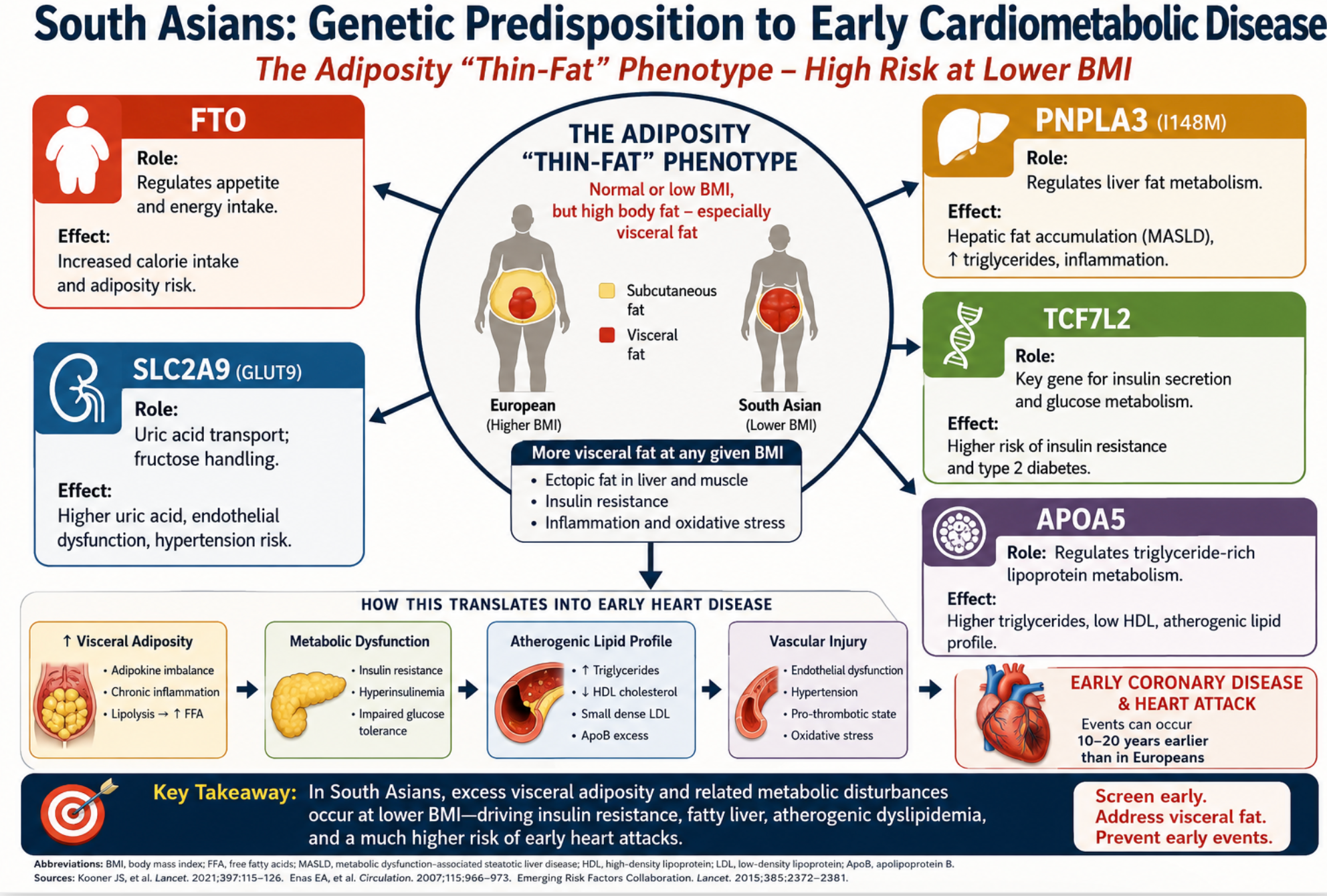
South Asian populations can develop type 2 diabetes and cardiometabolic complications at lower body mass index values than many European-origin populations. BMI alone can therefore miss risk. Waist circumference, blood pressure, glucose or HbA1c, blood lipids, family history, pregnancy history, tobacco exposure, physical activity, and access to care all contribute to a more useful assessment.
WHO reports a large diabetes burden and major diagnosis and treatment gaps across its South-East Asia Region, which includes several South Asian countries as well as countries outside South Asia. Regional totals should not be presented as South Asia-only estimates. The practical implication is clear: prevention must be paired with affordable primary-care detection, evidence-based treatment, and long-term control of glucose, blood pressure, and lipids.
Metabolic liver disease
MASLD is the current term for liver fat accumulation associated with metabolic risk factors. A global systematic review and meta-analysis published in 2023 estimated pooled fatty-liver prevalence in South Asia at 33.83%, with a wide 95% confidence interval of 22.91% to 46.79%. This pooled estimate combines heterogeneous studies with different populations and diagnostic methods; it is not a prevalence figure for every South Asian country or community.
Liver health should be considered alongside diabetes, central adiposity, triglycerides, blood pressure, and cardiovascular risk. People can have clinically important metabolic risk without appearing visibly obese, but population screening and individual testing decisions should follow appropriate national or professional guidance rather than a single regional statistic.
Food traditions and national dietary guidance
South Asia has no single traditional diet. Useful foundations differ by place and may include lentils and other pulses, chickpeas, beans, minimally refined grains, millets, vegetables, fruit, nuts and seeds, yogurt or other fermented foods, eggs, fish, and modest portions of meat where culturally appropriate. Cooking method, portion size, food safety, affordability, and the balance of the whole meal matter as much as the name of a staple.
India’s ICMR–National Institute of Nutrition released revised Dietary Guidelines for Indians in 2024. The guidelines emphasize dietary diversity, vegetables and fruit, pulses and other protein foods, appropriate use of cereals and millets, food safety, label reading, and limiting highly processed foods. Nepal’s national guidance similarly recommends wholegrain cereals, vegetables and fruit, pulses, less sugar and sweetened drinks, safe water, and locally available traditional foods. Country guidance should shape country-specific recommendations rather than treating South Asia as nutritionally uniform.
Taxes and healthier food environments
Education alone cannot overcome price, availability, and marketing. WHO identifies excise taxes on sugar-sweetened beverages as a policy option and notes that tax design, inflation adjustment, administration, consumer protection, and nutrition labelling affect implementation. Sri Lanka has been a regional case study in the design of sugary-drink taxation, but tax rates and regulations can change and should be checked against current national law before publication or advocacy.
Complementary measures include clear front-of-pack information, protection of children from unhealthy food marketing, healthy school-food and public-procurement standards, reformulation that is independently monitored, safe drinking water, and policies that make minimally processed foods affordable. Policy evaluation should examine purchases, product composition, substitution, equity, and health outcomes—not merely whether a rule exists.
Agriculture, affordability, and resilience
A healthier food transition can support agriculture rather than reject it. Pulses, millets, vegetables, fruit, nuts, seeds, and regionally appropriate animal-source foods can strengthen dietary diversity while supporting farmers and local markets. Investment in storage, cold chains, irrigation efficiency, food testing, transport, and market access can reduce losses and improve the reliable supply of perishable foods.
The goal is not romanticizing the past. Traditional diets sometimes lacked adequate energy, protein, micronutrients, or food safety, especially for children and pregnant women. South Asia needs double-duty food policy: prevent undernutrition and micronutrient deficiency while reducing excessive exposure to refined, heavily marketed, nutrient-poor products.
Priorities for South Asia
Priority actions include comparable country-level surveillance; affordable primary-care screening and treatment; implementation of national dietary guidelines; healthier school and workplace food; protection of children from harmful marketing; safe water; stronger food labels; support for pulses, millets, vegetables, fruit, and other locally appropriate foods; and careful evaluation of beverage taxes and other fiscal policies.
The central opportunity is to preserve the diversity and social structure of useful regional food traditions while applying modern nutrition science, food-safety systems, and chronic-disease care. The strongest response will be locally designed, measurable, and honest about differences among countries, communities, income groups, and life stages.
Selected authoritative sources
WHO South-East Asia, management of diabetes: https://www.who.int/southeastasia/activities/management-of-diabetes
WHO South-East Asia, taxes on sugary drinks: https://www.who.int/southeastasia/news/feature-stories/detail/taxes-on-sugary-drinks
ICMR–National Institute of Nutrition, Dietary Guidelines for Indians 2024: https://nin.res.in/dietaryguidelines/pdfjs/locale/DGI_2024.pdf
FAO, food-based dietary guidelines for Nepal: https://www.fao.org/nutrition/education/food-dietary-guidelines/regions/nepal/en/
Riazi K et al., global epidemiology of fatty liver disease, systematic review and meta-analysis: https://pubmed.ncbi.nlm.nih.gov/36626630/
WHO South-East Asia, obesity and the double burden of malnutrition: https://www.who.int/southeastasia/health-topics/obesity
Genetic susceptibility, body-fat distribution, and environment
South Asia’s elevated metabolic risk cannot be attributed to one gene, one body type, or ancestry alone. Type 2 diabetes and related cardiometabolic diseases are polygenic: many variants each contribute a small part of risk, while early-life nutrition, diet, physical activity, socioeconomic conditions, and the food environment strongly influence whether susceptibility becomes disease.
A 2024 Nature Medicine study analyzed genetic pathways in the Genes & Health cohort of 50,556 British Pakistani and British Bangladeshi participants, including 11,678 people with type 2 diabetes. Polygenic susceptibility involving reduced insulin secretion and unfavorable fat distribution was associated with younger diagnosis, faster progression, and complications. Participants with high genetic risk in both pathways were diagnosed about 8.2 years earlier and at a BMI approximately 3 kg/m² lower than those with low risk in both pathways.
These results help explain why BMI alone can underestimate risk, but they should not be generalized uncritically to every South Asian population. Waist circumference, glucose or HbA1c, blood pressure, triglycerides, HDL cholesterol, family history, pregnancy history, and other clinical factors provide information that BMI cannot capture.
A separate genome-wide association meta-analysis included 16,677 South Asian participants with type 2 diabetes and 33,856 controls. It identified 21 previously unreported susceptibility loci, while a South Asian-derived polygenic score showed roughly fourfold higher diabetes risk between its highest and lowest quartiles. Polygenic scores remain research and emerging clinical tools; they are not stand-alone diagnostic tests.
How to read the genetics diagram
The diagram is a conceptual overview, not a diagnostic genetic model. FTO is associated with appetite and adiposity; TCF7L2 is most strongly linked to pancreatic beta-cell function and insulin secretion rather than simply to insulin resistance; PNPLA3 variants can influence susceptibility to metabolic liver disease; and APOA5 participates in triglyceride-rich lipoprotein metabolism. These variants are not exclusive to South Asians, and no individual variant determines a person’s outcome.
SLC2A9 encodes the GLUT9 urate transporter and is strongly involved in uric-acid handling. Its relationship with fructose exposure, blood pressure, and cardiovascular disease is biologically and epidemiologically complex, so the diagram’s arrows should be understood as possible pathways and associations rather than proof of direct causation.
The so-called thin-fat phenotype—greater visceral or ectopic fat at a comparatively low BMI—also reflects developmental, epigenetic, nutritional, and environmental influences. Genetics can change probability; it does not make diabetes, fatty liver, or heart disease inevitable.
An early observation of diet meeting susceptibility
In 1907, Sir Richard Henry Havelock Charles, a physician and surgeon in the Indian Medical Service, reported that diabetes was increasing rapidly among wealthier Bengali residents of Calcutta while remaining uncommon among poorer Punjabi populations. He associated this contrast with greater consumption of sugar and refined, starch-rich foods among affluent urban groups.
This historical observation did not prove that sugar alone caused diabetes. It was not a modern epidemiological study and could not adequately separate diet from total energy intake, physical activity, social class, diagnostic access, genetics, or other factors. Its importance is that physicians were already observing a relationship between metabolic disease, affluence, and a changing food environment more than a century ago.
Modern genetics adds an important qualification. South Asian populations can carry polygenic susceptibility involving insulin secretion and fat distribution, but inherited risk is not destiny. The social contrast described in 1907 supports a gene–environment interpretation: underlying susceptibility may become clinically visible when food availability, processing, physical activity, and other environmental exposures change.
Genetics and historical sources
Hodgson S et al., Nature Medicine (2024), genetic basis of early-onset and progressive type 2 diabetes in South Asians: https://www.nature.com/articles/s41591-024-03317-8
Mahajan A et al., Communications Biology (2022), South Asian and European type 2 diabetes genetics: https://www.nature.com/articles/s42003-022-03248-5
Johnson RJ et al., historical and scientific perspective on sugar, obesity, and diabetes: https://pmc.ncbi.nlm.nih.gov/articles/PMC5421126/
Explore Full Atlas of the Global Metabolic Crisis
Main Global Crisis Page • How the Metabolic Crisis Developed • Rising Chronic Disease
Regions:
Africa • Europe • Middle East and North Africa • South Asia • East Asia • Southeast Asia • Oceania and Pacific Islands • Latin America and Caribbean • North America
South Asia country navigation
South Asia • Afghanistan • Bangladesh • Bhutan • India • Maldives • Nepal • Pakistan • Sri Lanka