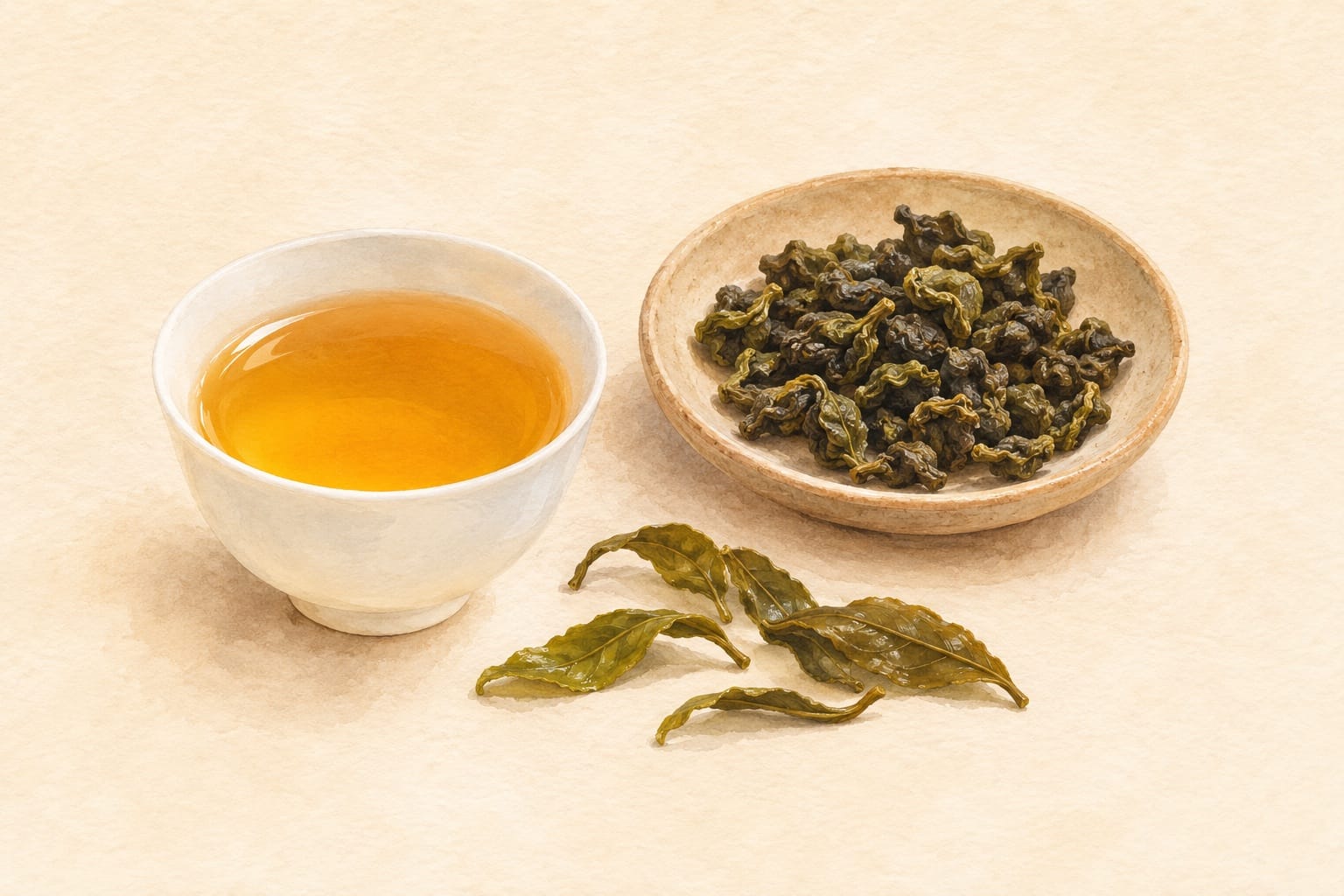
Heritage in a glass · Anxi, Fujian · China
Oolong offers a wide range of aromas without needing a sweet flavouring. Anxi in China’s Fujian province provides a specific place and community through which to explore that range.
- Flavour
- Floral or toasted · layered · variable by tea
- Caffeine
- Contains caffeine; roast and colour do not establish its amount
- Added sugar
- 0 g added in this plain recipe
- Recipe and heritage
- Plain leaf tea needs no added sweetener; this is a simple household brew.
Start with a place and its makers
FAO recognises the Anxi Tieguanyin Tea Culture System as a Globally Important Agricultural Heritage System. Its account highlights locally developed tea-making and propagation skills, their role in livelihoods, and an evolving cultural practice. Tieguanyin is a particular oolong tradition; it is not a name for all Chinese tea. FAO: Anxi Tieguanyin Tea Culture System.
UNESCO’s recognition of Chinese tea-processing and associated social practices also describes tea as part of welcoming guests, maintaining family relationships and passing skills between generations. A cup links the drinker to people who cultivate and make the leaves. UNESCO: traditional tea processing and social practices in China.
What makes oolong different?
Oolong is a category of partly oxidised tea, with styles ranging from lightly processed floral leaves to more deeply roasted examples. Oxidation is part of how the leaf changes during processing. The “semi-fermented” wording used in some tea descriptions does not mean this cup is an alcoholic fermented drink. Anxi’s traditions represent one part of this wider category. FAO: Anxi Tieguanyin Tea Culture System.
Choose a labelled plain oolong from a reliable supplier. A golden-amber illustration represents one style; pale greenish and darker amber brews can also occur. The cup’s colour does not tell you how much caffeine it contains.
A simple household infusion
Makes: about 500 mL, four 125 mL servings. Time: approximately 3–5 minutes after heating the water.
- 3 g plain loose-leaf oolong, or the packet’s quantity for 500 mL
- 500 mL drinking-quality water
- No sugar, milk, syrup or flavouring
- Use a clean heat-safe pot. Heat the water to the temperature specified on the tea packet. If the seller provides no guidance, 90–95°C is an editorial starting point for many roasted styles.
- Add water to the leaves and steep for about 3 minutes, or follow the packet’s time. Strain completely.
- Let the tea cool to a comfortable drinking temperature. For a later infusion, follow the seller’s instructions and remember that refills add to your caffeine intake.
This low-leaf household method is not a full gongfu tea ceremony. Traditional small-vessel brewing can use different leaf-to-water ratios and much shorter infusions. Let the tea and its maker’s guidance lead the method.
Caffeine is part of the choice
This drink contains caffeine. The amount varies with the beans or leaves, quantity, brewing and refills; we have not measured this recipe. Consider sleep, sensitivity and medicines, and seek individual advice during pregnancy or breastfeeding. These caffeinated recipes are intended for adults. FDA: caffeine in drinks and individual sensitivity.
Choose a smaller serving or another drink if caffeine causes palpitations, anxiety or sleep problems. Oolong is not a caffeine-free substitute for water, and no claim is made that it treats metabolic disease or causes weight loss.
Credit the tea you actually buy
If your tea is grown or made somewhere other than Anxi, name that origin honestly. You can appreciate Anxi’s contribution while acknowledging the many other communities that make oolong. A familiar category name does not establish the origin of an individual packet.
What “no added sugar” means
The recipe adds no sugar, honey, syrup, juice or sweetener. That is an ingredient statement, not a laboratory measurement of total sugars, calories or carbohydrate. The finished drink has not been analysed. Check commercial mixes, bottles and café preparations separately.
Prepare and serve with care
Use drinking-quality water, clean utensils and correctly identified ingredients sold for food use. Follow packet brewing instructions. For herbal infusions, use freshly boiling water and at least five minutes of infusion unless the product requires longer. BfR: boiling water for herbal infusions.
Enjoy freshly prepared. For a chilled batch, cool promptly in smaller heat-safe containers and refrigerate at 4°C / 40°F or below. As a conservative household rule adapted from general food guidance, refrigerate within two hours, or one hour above 32°C / 90°F. This is not a tested shelf life for these recipes. FDA: safe food handling.
Keeping ingredients in perspective
Water, traditional infusions, coffee and modern soft drinks all contain chemical substances. “Chemical” alone does not tell us whether something is harmful: identity, amount and individual circumstances matter. Modern sodas differ in formulation, just as traditional recipes do. Compare actual ingredients and servings rather than assuming that every soda is the same or every old recipe is safe for everyone. FDA: is food safe if it has chemicals?.
Sources and further reading
Questions about this drink
What can I drink instead of sweetened bottled tea?
Plain brewed oolong is one option. This guide uses tea leaves and water with no added sugar, honey or syrup. Its flavour varies by tea and preparation; a bottled oolong product may have a different ingredient list and sugar content.
Does unsweetened oolong still contain caffeine?
Yes. Removing sweetener does not remove the caffeine naturally present in the tea leaves. Leaf quantity, brewing and repeated infusions affect the amount consumed. We have not measured the caffeine in this household recipe.
Medical disclaimer
Educational resources only. Internets.com cannot provide personal medical advice, diagnosis, treatment recommendations, lab interpretation, or case review.
This information does not replace individual medical or dietary care. Consult a qualified health professional who knows your circumstances about medicines, allergies, pregnancy, breastfeeding, children, or existing illness. Do not stop or change prescribed treatment because of a beverage recipe.
Prepared 15 November 2026 · Internets Press. Household serving suggestions; no clinical reviewer is attributed.