A practical metabolic explanation for the emerging cancer signal
Key message
GLP-1 receptor agonists do not directly block fructose metabolism. They are not ketohexokinase inhibitors. However, they may oppose the upstream metabolic consequences of chronic fructose excess: increased appetite and energy intake, liver fat, insulin resistance, visceral adiposity, chronic inflammation, and growth-factor signaling.
Why this matters
New reports presented at the 2026 American Society of Clinical Oncology meeting suggest that GLP-1 drugs may be associated with lower cancer incidence, lower metastatic progression, better survival, or improved treatment response across several cancers. The cancers discussed include breast cancer, colorectal cancer, hepatocellular carcinoma, pancreatic cancer, renal cancer, lung cancer, and others.
This evidence is promising, but it is not yet proof that GLP-1 drugs prevent cancer. Much of the current evidence remains observational. People who receive these drugs may differ from nonusers in weight, diabetes control, screening patterns, medication history, health-care access, and other confounders. Randomized trials and longer follow-up are still needed.
The fructose connection
Fructose is not just another calorie. In excess, particularly from sugar-sweetened beverages, high-fructose corn syrup, and excess sucrose, fructose creates a liver-centered metabolic burden. Frequent exposure promotes de novo lipogenesis, triglyceride production, fatty liver, uric-acid generation, insulin resistance, and visceral adiposity.
Those abnormalities do not remain isolated in the liver. They create a whole-body metabolic environment characterized by hyperinsulinemia, insulin-like growth-factor signaling, chronic inflammation, altered adipokines, oxidative stress, and impaired immune-metabolic control. These are among the biological pathways linking obesity and metabolic syndrome to increased risk of several cancers.
What GLP-1 drugs may be teaching us
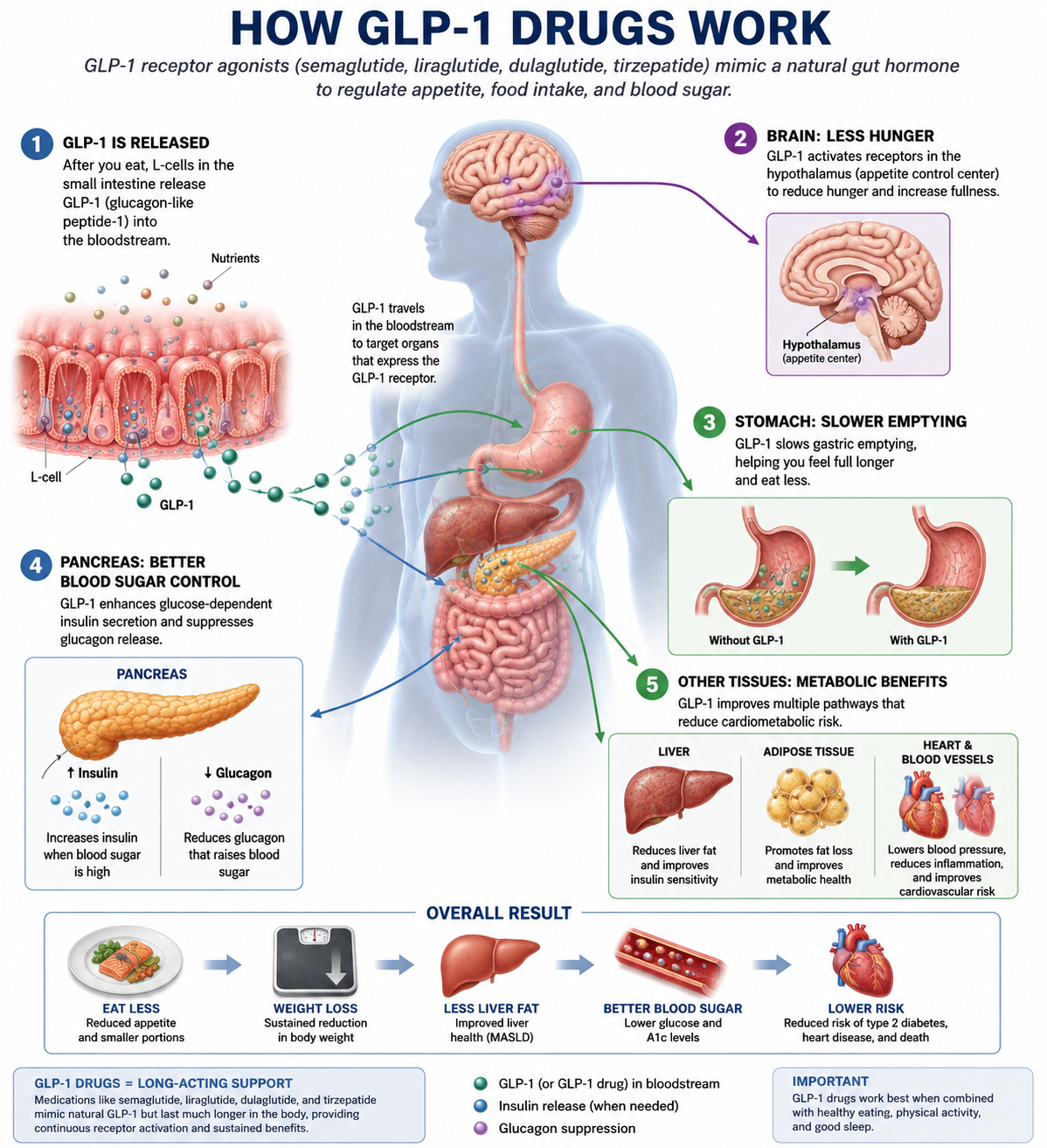
GLP-1 therapy appears to move metabolism in the opposite direction. These drugs reduce appetite and total energy intake, improve glycemic control, lower insulin demand, reduce body weight and visceral fat, and may improve fatty liver biology and inflammatory signaling.
The emerging cancer findings are therefore biologically coherent. GLP-1 drugs may not be acting as direct anticancer drugs in the traditional sense. Instead, they may be reducing the upstream metabolic pressure that helps create a cancer-permissive terrain.

Figure. GLP-1 receptor agonists do not directly neutralize fructose metabolism. Their importance may be upstream: they move metabolism away from the fatty-liver, insulin-resistant, inflammatory terrain that chronic fructose excess helps create. Current cancer data are promising but remain largely observational.
Breast, colorectal, and endometrial cancer
The current signal is especially relevant for cancers already linked to obesity and metabolic dysfunction. Postmenopausal breast cancer risk is influenced by adiposity, insulin resistance, estrogen biology, and inflammation. Colorectal cancer risk is linked to obesity, diabetes, metabolic syndrome, diet quality, and chronic inflammation. Endometrial cancer is particularly connected to obesity, hyperinsulinemia, and altered hormonal signaling.
This does not mean that fructose alone causes these cancers. Cancer is multifactorial. Genetics, age, alcohol, smoking, reproductive history, microbiome, activity level, screening, and environmental exposures all matter. However, fructose-rich ultra-processed diets are plausible upstream contributors to the metabolic terrain in which these cancers become more common.
Practical message
Patients should not interpret this research as permission to continue a high-sugar diet while relying on medication. GLP-1 drugs may help reverse some of the metabolic damage created by the modern food environment, but they do not make sugar harmless.
The foundation remains the same: remove sugar-sweetened beverages, reduce ultra-processed foods, protect the liver, lower triglycerides, improve waist circumference, and restore metabolic health. The new GLP-1 cancer signal supports the larger argument that cancer prevention may begin far upstream, at the level of metabolic fuel handling.
Bottom line
The most accurate statement is not that GLP-1 drugs block fructose metabolism. The stronger statement is that GLP-1 drugs appear to oppose the upstream metabolic consequences of chronic fructose excess.
That distinction is important. It keeps the claim scientifically accurate while strengthening the central thesis: if the upstream metabolic flood is reduced, some downstream cancer risks may also fall.
References
- Wang L, Xu R, Kaelber DC, Berger NA. Glucagon-like peptide 1 receptor agonists and 13 obesity-associated cancers in patients with type 2 diabetes. JAMA Netw Open. 2024;7(7):e2421305. doi:10.1001/jamanetworkopen.2024.21305.
- Wang L, Wang W, Kaelber DC, Xu R, Berger NA. GLP-1 receptor agonists and colorectal cancer risk in drug-naive patients with type 2 diabetes, with and without overweight/obesity. JAMA Oncol. 2024;10(2):256-258. doi:10.1001/jamaoncol.2023.5573.
- Dai H, Alsamarraie C, Kanagalingam T, et al. GLP-1 receptor agonists and cancer risk in adults with obesity. JAMA Oncol. 2025;11(10):1186-1193. doi:10.1001/jamaoncol.2025.2681.
- American Society of Clinical Oncology. GLP-1s may reduce metastatic progression of certain obesity-related cancers. ASCO Press Center. Published 2026.
- Reuters. GLP-1 drugs may have a beneficial effect across many types of cancer. Published June 3, 2026.