Introduction
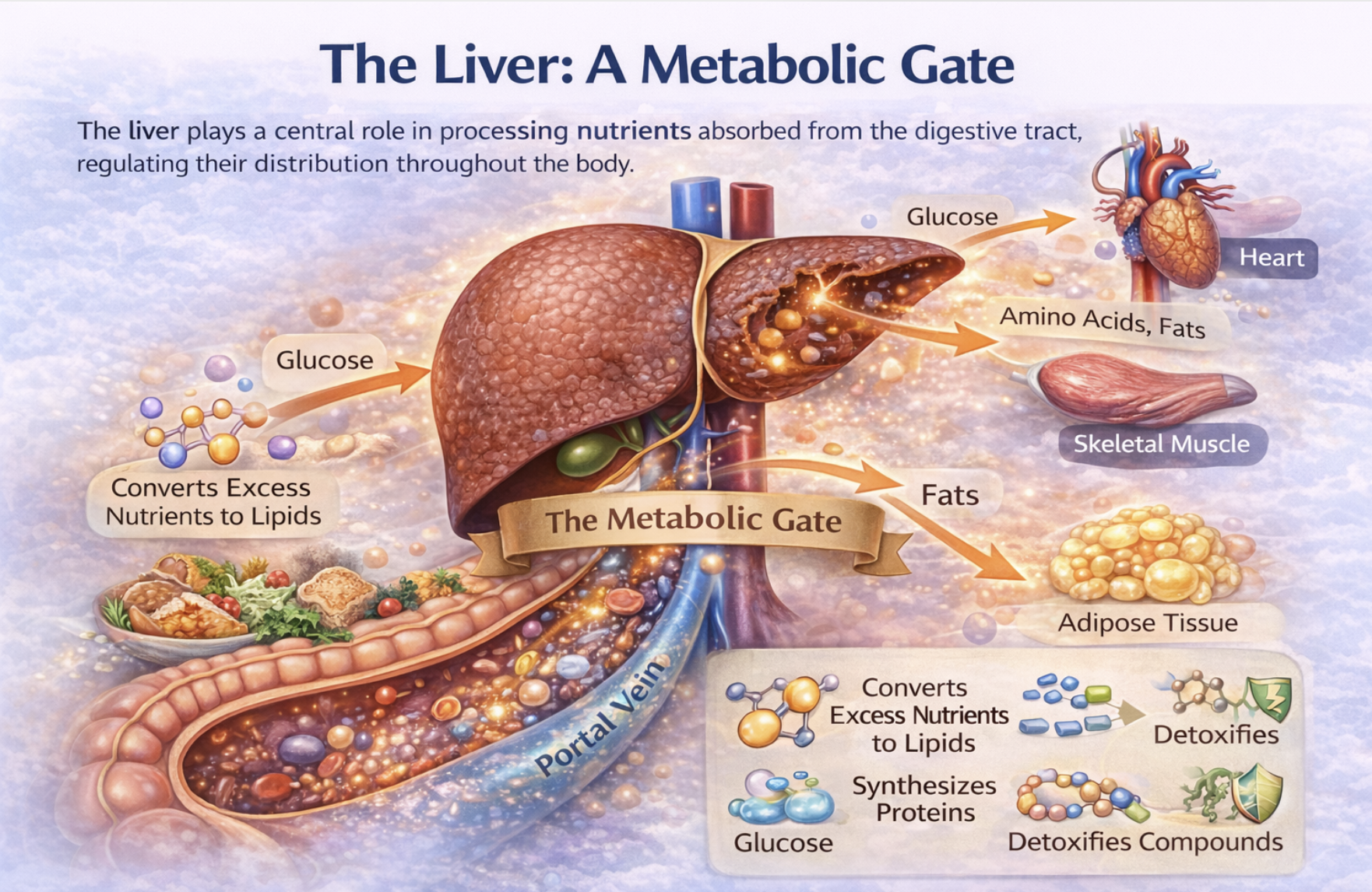
The liver occupies a unique position in human metabolism. Almost everything absorbed from the digestive system passes through the liver before entering the general circulation. Because of this anatomical arrangement, the liver acts as a metabolic gate between the intestine and the rest of the body.
This role allows the liver to regulate how nutrients are processed, stored, and distributed. It also means that the liver is often the first organ affected when metabolic regulation becomes disturbed.
Understanding the liver’s role as the metabolic gate helps explain why many metabolic disorders—including fatty liver disease, insulin resistance, and dyslipidemia—originate in hepatic metabolism.
The Portal Circulation
After food is digested in the intestine, nutrients are absorbed into the bloodstream through a network of vessels known as the portal circulation.
These vessels merge to form the portal vein, which carries nutrient-rich blood directly to the liver. Unlike most organs, which receive blood from the heart first, the liver receives blood that has just absorbed nutrients from the digestive tract.
This arrangement allows the liver to process nutrients before they circulate throughout the body.
Nutrient Processing in the Liver
Once nutrients reach the liver, hepatocytes determine how they will be used.
The liver can:
• store glucose as glycogen
• convert excess carbohydrates into fatty acids
• synthesize triglycerides and lipoproteins
• regulate blood glucose levels
• detoxify certain compounds
Through these functions, the liver helps maintain metabolic balance despite variations in dietary intake.
Fructose Metabolism
Fructose metabolism illustrates the liver’s gatekeeping role particularly clearly.
Unlike glucose, which can be metabolized by many tissues, fructose is processed primarily in the liver. After absorption in the intestine, fructose travels through the portal vein and enters hepatic metabolic pathways involving enzymes such as ketohexokinase (KHK).
These pathways influence ATP balance, lipid synthesis, and metabolic signaling.
Because the liver is exposed to high concentrations of dietary fructose, it plays a central role in determining how fructose affects metabolism.
Lipid Production
The liver also regulates lipid metabolism.
When excess carbohydrates are present, the liver can convert these nutrients into fatty acids through de novo lipogenesis. These fatty acids are assembled into triglycerides and transported through the bloodstream in lipoprotein particles.
When lipid production exceeds the liver’s capacity to export fats, triglycerides accumulate in hepatocytes, leading to fatty liver disease.
The Liver and Metabolic Disease
Because the liver processes nutrients before they reach other organs, disturbances in hepatic metabolism can influence multiple systems.
Changes in liver metabolism may affect:
• insulin signaling
• triglyceride production
• lipoprotein metabolism
• inflammatory pathways
These interactions help explain why metabolic disorders frequently involve the liver.
A Central Metabolic Organ
The liver’s strategic position between the digestive system and systemic circulation allows it to regulate the flow of nutrients throughout the body.
This function makes the liver one of the most important organs in metabolic physiology.
Understanding its role as the metabolic gate provides insight into how dietary patterns influence metabolic health.
Related pages
Industrial Fructose Era (Post-1984)
The Portal Vein
Ultra-Processed Foods and the Modern Diet
Global Metabolic Crisis
Recent Evidence: The Gut-Liver Axis of Fructose
Summary: The liver is a central metabolic gate because absorbed nutrients, including fructose, arrive through the portal circulation. But recent work also emphasizes the intestine and microbiome as active participants.
Marielle Cheikh and Fernando Forato Anhê reviewed how excess fructose can affect gut microbial and metabolic regulation. Their 2026 review is useful because it broadens the liver story: fructose exposure can involve intestinal metabolism, microbial communities, hepatic fat handling, MASLD, obesity, and type 2 diabetes.
The liver-gate model is still valid, but the better current model is gut-liver metabolic traffic: fructose handling begins in the intestine, reaches the liver through portal blood, and can interact with microbiome-derived signals, uric acid, triglyceride production, and insulin resistance.
Source: Cheikh M. and Anhê F.F., Biochemical Journal, 2026, PMID 42233430.
Recent Evidence: Added Sugars, Lipids, and Uric Acid
Summary: Fructose can contribute to triglyceride production by supplying carbon to hepatic lipid pathways and by altering liver energy handling. The clinical signal is strongest when fructose-containing sugars are added to the diet in beverages or processed foods.
A 2025 systematic review and meta-analysis by Prasetya Guntari, Astina Junaida, Palupi Eny, Namkieat Pichamon, Jiamjarasrangsi Wiroj, and Suwimol Sapwarobol found that short-term added-sugar interventions had mixed effects across metabolic markers. Importantly, fructose interventions, especially those using high-fructose corn syrup, showed marked increases in uric acid. This is useful because it adds nuance: acute trials may not show every chronic disease pathway, but uric acid and lipid signals remain biologically important.
Practical interpretation: triglycerides, uric acid, liver fat, and insulin resistance should be read together. A normal fasting glucose does not rule out early metabolic stress when triglycerides, waist size, ALT, uric acid, or fatty liver risk are changing.
Sources: Guntari P. et al., Food & Nutrition Research, 2025, PMID 41323133; Hannou S.A. et al., Journal of Clinical Investigation, 2018, PMID 29388924.
Related Fructose Science Pages
The liver receives absorbed nutrients through the portal circulation. For the larger disease pathway connecting fructose biology, insulin resistance, liver fat, and inflammation, see The Biology of Metabolic Disease.