PNPLA3 and Fatty Liver Disease: Why Genetics and Modern Diet Interact
Introduction
Not everyone exposed to the modern Western diet develops liver disease at the same rate. One reason may involve inherited differences in how the liver handles fat.
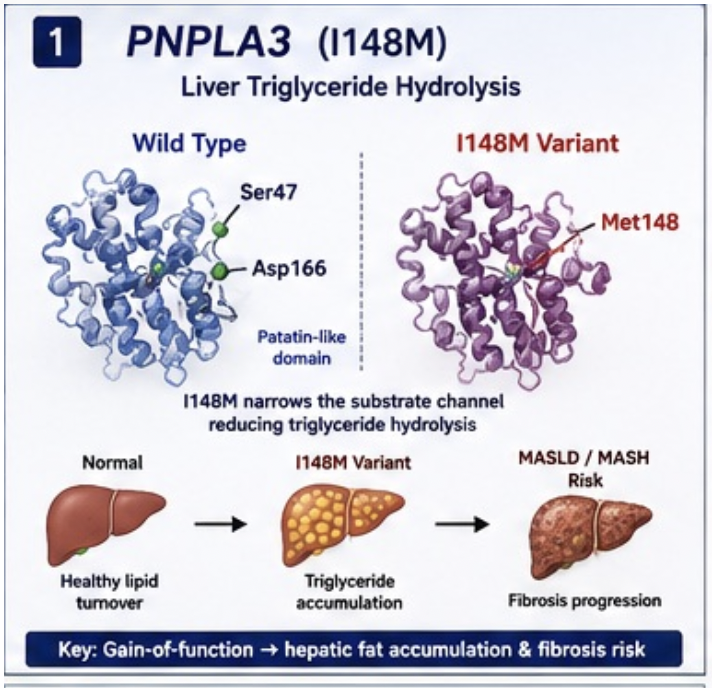
A common genetic variant known as PNPLA3 has emerged as one of the strongest inherited risk factors for metabolic dysfunction–associated steatotic liver disease (MASLD), previously known as nonalcoholic fatty liver disease (NAFLD). The effect appears especially important when combined with modern dietary exposures such as sugary beverages, excess fructose, ultra-processed foods, obesity, and visceral fat accumulation.
Importantly, genes are not destiny. PNPLA3 appears to influence susceptibility, while modern food exposure and lifestyle largely determine whether disease develops and progresses.
What Is PNPLA3?
PNPLA3 stands for patatin-like phospholipase domain-containing protein 3. The gene helps regulate fat handling inside liver cells.
Researchers became especially interested in a common variant called:
rs738409 (I148M)
This small genetic change alters how liver cells process and export triglycerides. The result can be increased fat retention within the liver.
Over time, this may contribute to:
- fatty liver
- liver inflammation
- fibrosis (scarring)
- cirrhosis
- hepatocellular carcinoma
The variant is now recognized as one of the strongest common genetic contributors to MASLD progression.
Why Modern Diet Matters
The gene does not act alone.
The modern industrial food environment appears to amplify the biological effect of PNPLA3, especially in the presence of:
- sugar-sweetened beverages
- excess fructose exposure
- ultra-processed foods
- obesity
- insulin resistance
- visceral adiposity
- alcohol excess
Fructose is especially relevant because it is processed primarily by the liver. High fructose exposure may increase liver fat production and metabolic stress in genetically susceptible individuals.
This helps explain an important modern observation:
Two individuals may consume similar diets, yet one progresses more rapidly toward fatty liver disease and fibrosis.
Why Do Allele Frequencies Differ Between Populations?
Human populations adapted over thousands of years to different climates, food environments, and ecological pressures. As populations migrated and diversified, certain genetic variants became more or less common through natural selection, founder effects, and genetic drift.
The PNPLA3 risk variant is reported more frequently in some Indigenous American and Latin American populations, with intermediate frequencies in many East Asian populations and lower frequencies in many African populations.
Importantly:
- no population is immune to modern metabolic disease
- no single gene determines destiny
- environmental exposure remains critically important
The rapid global spread of industrialized diets has likely outpaced the ability of human biology to adapt.
PNPLA3 and Fatty Liver Disease
Research now links PNPLA3 with:
- increased liver fat accumulation
- steatohepatitis (MASH/NASH)
- advanced fibrosis
- cirrhosis
- hepatocellular carcinoma
The effect appears strongest when combined with metabolic overload.
Clinically, this means some patients may develop advanced liver disease despite only modest elevations in liver enzymes. Others may progress more rapidly than expected.
This is one reason why clinicians increasingly pay attention to:
- liver imaging
- fibrosis assessment
- FIB-4 scoring
- FibroScan/VCTE
- metabolic risk factors
- family history
Why Cardiologists Should Care
The liver and cardiovascular system are closely connected.
Modern MASLD is associated with:
- insulin resistance
- elevated triglycerides
- visceral adiposity
- systemic inflammation
- hypertension
- Type 2 diabetes
- heart failure with preserved ejection fraction (HFpEF)
Recent cardiology guidelines and state-of-the-art reviews increasingly encourage cardiovascular clinicians to recognize and screen for fatty liver disease.
For many patients, the liver may be one of the earliest visible signs of broader metabolic dysfunction.
Can Risk Be Reduced?
Although genetics cannot currently be changed, metabolic stress on the liver often can be reduced.
Strategies associated with lower metabolic risk include:
- reducing sugar-sweetened beverages
- limiting excess fructose exposure
- minimizing ultra-processed foods
- weight reduction when appropriate
- regular physical activity
- improving sleep and metabolic health
- reducing visceral adiposity
- careful alcohol moderation
Many traditional dietary patterns around the world contained fewer industrial sugars and ultra-processed foods than modern diets.
A Broader Lesson
PNPLA3 illustrates a broader principle in modern metabolic disease:
Human genetics evolved gradually over thousands of years, while the global food environment changed dramatically within only a few generations.
The result may be a growing mismatch between ancient biology and modern industrial nutrition.
Related Pages
- What Is Fatty Liver Disease?
- Fructose and the Liver
- Metabolic Syndrome Explained
- Insulin Resistance
- Uric Acid and Metabolic Health
- HFpEF and Metabolic Disease
- Global Metabolic Crisis
Suggested References
- Romeo S, Kozlitina J, Xing C, et al. Genetic variation in PNPLA3 confers susceptibility to nonalcoholic fatty liver disease. Nat Genet. 2008;40:1461-1465.
- Khan MS, et al. The Basics of Metabolic Dysfunction–Associated Steatotic Liver Disease for Cardiologists: Pathophysiology, Diagnosis, and Treatment. J Am Coll Cardiol. 2025;86:1861-1884.
- Souza MR, et al. PNPLA3 polymorphisms and metabolic liver disease: emerging clinical implications. J Clin Exp Hepatol. 2025.
- Lazo M, et al. Genetics and NAFLD progression across populations. Hepatology. 2022.
- Younossi ZM, et al. Global epidemiology of MASLD/NAFLD. Nat Rev Gastroenterol Hepatol. 2024.