World Map of Childhood Obesity Trajectories
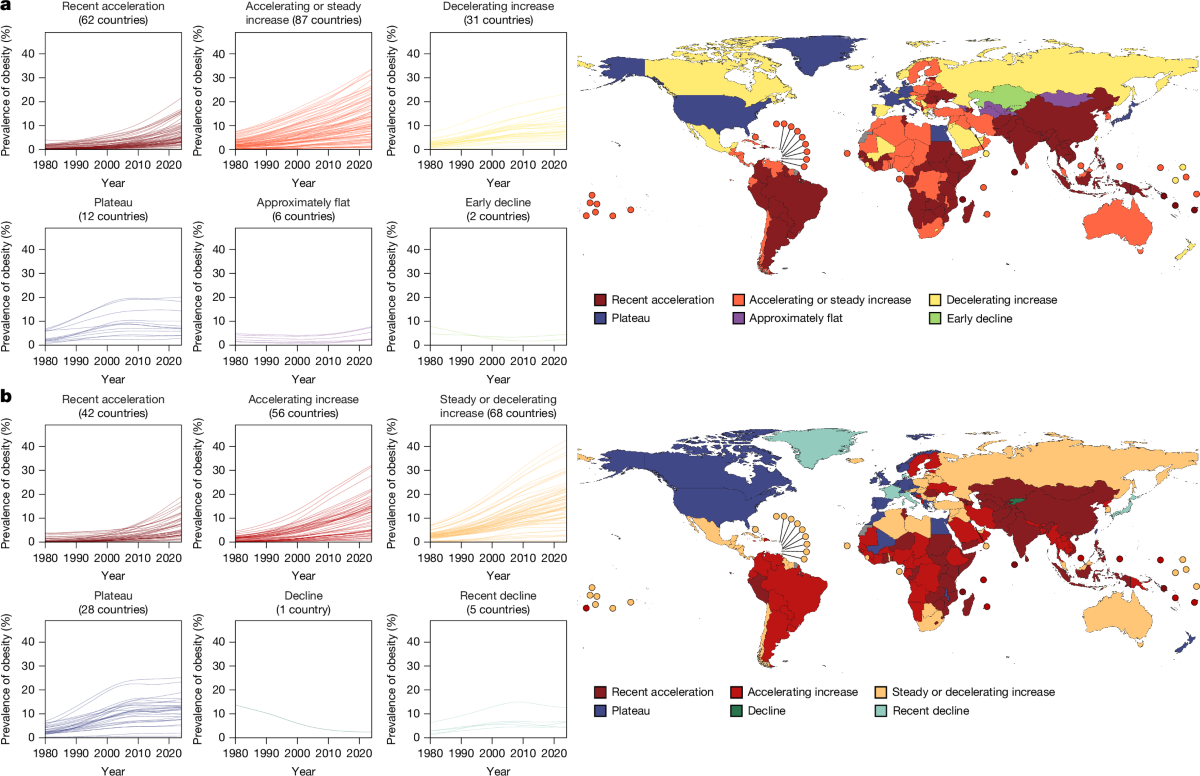
Figure 1. National obesity-trajectory patterns among girls and boys, 1980–2024. The maps group countries by the shape of their estimated prevalence trends, making the changing geography easier to compare than the detailed country-by-country circular timeline.
Source and licence: NCD Risk Factor Collaboration (NCD-RisC), Nature 653, 510–518 (2026), doi:10.1038/s41586-026-10383-0. Reproduced without modification under CC BY 4.0.
A New Global Map of Childhood Obesity Change
The 2026 NCD Risk Factor Collaboration analysis provides two measurements that should be read together: prevalence, the proportion of children and adolescents living with obesity, and velocity, the estimated year-to-year change in prevalence. This distinction prevents a common error. The country with the highest current prevalence is not necessarily the country where obesity is now increasing fastest.
The analysis combined 4,050 population-based studies involving 232 million participants across 200 countries and territories and estimated national trends from 1980 through 2024. It found that childhood and adolescent obesity has plateaued or slowed in some high-income settings while accelerating across many low- and middle-income countries.
How to read the figure: Red indicates a year-to-year increase in obesity prevalence, green a decrease, and white little or no change. The upper maps show estimated velocity in 2024; the lower maps show age-standardized prevalence in 2024. Girls and boys are displayed separately.
This evidence strengthens the case for country-specific prevention. Places with a high established burden need sustained treatment and prevention capacity; places with rapid current increases may have a narrowing window in which school-food standards, restrictions on marketing to children, access to water, protection of traditional food systems, and policies addressing sugary drinks and ultra-processed foods can alter the trajectory.
Source and licence: NCD Risk Factor Collaboration (NCD-RisC), “Obesity rise plateaus in developed nations and accelerates in developing nations,” Nature 653, 510–518 (2026), https://doi.org/10.1038/s41586-026-10383-0. Figure 2 reproduced without modification under the Creative Commons Attribution 4.0 International licence.
See the companion adult maps and global interpretation →Childhood obesity is not a failure of children or families. It is a public-health signal that the food environment has changed faster than families can defend against it.
A historic global turning point
For decades, the familiar image of childhood malnutrition was a child who did not have enough to eat. That crisis has not disappeared. But a second form of malnutrition has expanded rapidly: children can consume abundant calories while receiving too little nourishing food.
UNICEF's 2025 Child Nutrition Report estimates that 391 million children and adolescents ages 5–19 are living with overweight, including 163 million living with obesity. Together with children under five, the worldwide burden is approximately 427 million young people. In 2025, global obesity prevalence among ages 5–19 surpassed underweight—9.4% versus 9.2%—for the first time.
This does not minimize hunger. It means communities must now confront both hunger and food environments dominated by cheap, heavily marketed products.
The burden is shifting toward families with the least power
Overweight among children ages 5–19 has more than doubled in low- and middle-income countries since 2000. These countries now account for roughly 81% of the global burden, up from 66% in 2000.
As countries develop, the social pattern often reverses. At first, overweight may be concentrated in wealthier households. As industrial food becomes cheap and ubiquitous, the burden moves toward poorer communities. Families may live in “food swamps” filled with convenience stores and fast-food outlets, while affordable whole and minimally processed foods remain difficult to find.
Modern poverty can therefore mean too many cheap calories and too little safe nourishment.
The crisis begins earlier than many people realize
The first classroom is the high chair. Taste preferences begin forming before a child can read a label or make an independent choice. In 13 of 20 low- and middle-income countries studied by UNICEF, more than half of children ages 6–23 months had consumed a sweet beverage or food the previous day.
Commercial first foods can reinforce this pattern. Products marketed as convenient and reassuring may be ultra-processed, intensely sweet, or designed to be eaten rapidly from a pouch. The problem is not an occasional emergency food. It is the repeated default during a sensitive period when children are learning texture, variety, satiety, and what a normal drink tastes like.
The food environment surrounds the child
Cheap calories are often easier to find than nourishing food. Sweet drinks and snacks are marketed across streets, schools, television, games, social media, and mobile phones. UNICEF's global U-Report found that 75% of more than 64,000 young people ages 13–24 had seen advertising for sugary or energy drinks, fast food, or snacks during the previous week.
The marketing does more than sell food. It sells fun, friendship, family bonding, energy, status, and identity. A child does not stand alone against a billion-dollar persuasion system.
Schools are part of the food environment, too. When safe drinking water is unavailable or expensive, sweet drinks become the easy default. When school grounds are surrounded by packaged snacks and sugary beverages, a “healthy choice” may exist only in theory.
Why this matters medically
Childhood obesity raises the risk of high blood pressure, metabolic fatty liver disease, type 2 diabetes, kidney disease, heart risk, stigma, and bullying. Type 2 diabetes once described as “adult-onset” is now appearing in children and adolescents. Long-term studies show that kidney, eye, nerve, and cardiovascular complications can emerge by early adulthood.
The diseases are arriving early because exposure is arriving early.
A no-blame response
BMI is a screening measure, not a moral judgment. Growth, age, sex, medical history, and clinical assessment all matter. Effective prevention begins with dignity: no body comparison, no shame, and no assumption that parents simply lack willpower.
Families need environments that make water, real meals, nourishing first foods, active play, sleep, and culturally meaningful food easier—not harder—to choose.
Sources: UNICEF Child Nutrition Report 2025; World Health Organization healthy-diet and childhood-obesity guidance; U.S. Centers for Disease Control and Prevention; TODAY Study Group, New England Journal of Medicine, 2021.