Part II of our three-part History of Sugar series
← Before 1984: How Sugar Reached the Modern Food Supply
After 1984: The Low-Fat Era, HFCS and the Changing Food Supply →
The modern history of sugar has a hinge.
It is 1984.
Before 1984, sugar consumption had already risen dramatically. High-fructose corn syrup was entering the American food supply, the diet-heart hypothesis had become increasingly influential, and scientists were debating whether fat, sugar, cholesterol—or some combination of these—was driving the epidemic of coronary heart disease.
After 1984, the nutritional landscape changed. Low-fat eating became one of the dominant public-health messages of the era. Foods rich in fat and cholesterol became symbols of cardiovascular danger, while manufacturers increasingly developed products capable of carrying a “low-fat” or “fat-free” identity.
At the same time, refined carbohydrates and added sugars remained deeply embedded in the processed-food supply.
Three events make 1984 pivotal:
- January 1984 — a landmark cholesterol-lowering clinical trial
- March 1984 — TIME magazine’s unforgettable bacon-and-eggs cover
- December 1984 — the NIH Consensus Development Conference on lowering blood cholesterol
The science underlying these events was substantial.
However, what the pivotal experiment actually demonstrated—and what the American public eventually heard—were not precisely the same thing.
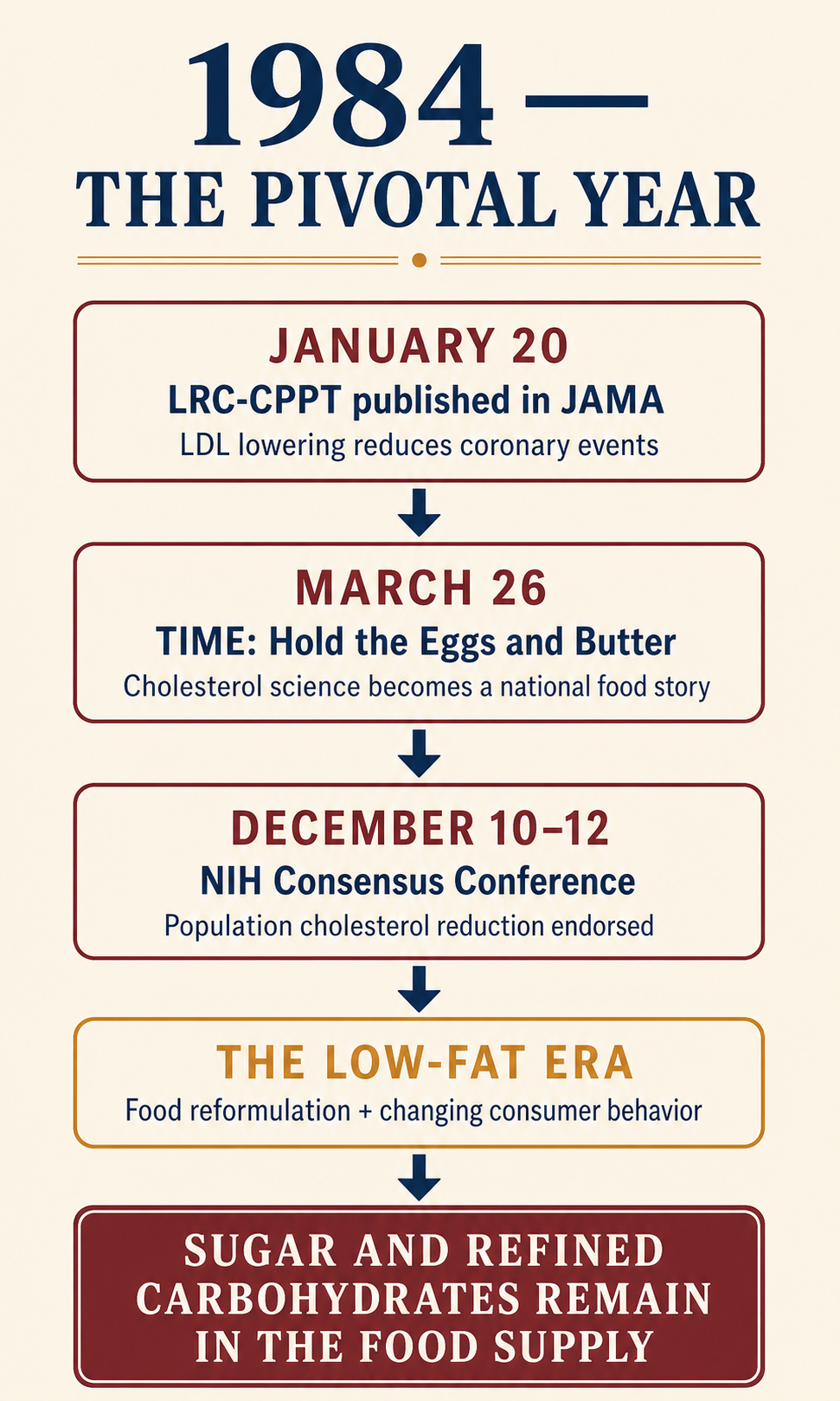
1984 — The Pivotal Year
Timeline graphic: In January, the LRC-CPPT showed that LDL lowering reduced coronary events; in March, cholesterol science became a national food story; in December, the NIH endorsed population cholesterol reduction. The low-fat era followed while sugar and refined carbohydrates remained in the food supply.
January 1984: What the Pivotal Experiment Actually Tested
The Lipid Research Clinics Coronary Primary Prevention Trial (LRC-CPPT) enrolled 3,806 asymptomatic middle-aged men with primary hypercholesterolemia.
Participants were randomized to:
- Cholestyramine plus a cholesterol-lowering diet
- Placebo plus the same cholesterol-lowering diet
That design is explicit in the original JAMA report. The cholestyramine group achieved approximately 8.5% greater total-cholesterol reduction and 12.6% greater LDL-cholesterol reduction, accompanied by a 19% relative reduction in the primary coronary heart disease endpoint. Read the LRC-CPPT design and results; read the relationship between cholesterol lowering and outcomes.
WHAT THE TRIAL SHOWED
Lowering substantially elevated LDL with cholestyramine reduced coronary events in hypercholesterolemic middle-aged men.
WHAT THE TRIAL DID NOT TEST
It did not randomize Americans to low-fat versus higher-fat diets. Both randomized groups received the same dietary intervention.
The Science Did Not Begin in 1984
Controlled feeding studies
Keys, Hegsted and others showed that dietary fatty-acid composition changes serum cholesterol.
Prospective epidemiology
Framingham showed that higher serum cholesterol predicts coronary risk.
International epidemiology
The Seven Countries Study documented large population differences in diet, cholesterol and coronary heart disease.
Human genetics and LDL-receptor biology
Brown and Goldstein’s work on familial hypercholesterolemia and LDL receptors provided powerful mechanistic evidence.
Intervention trials
Oslo, the Los Angeles Veterans trial, the Finnish Mental Hospital Study, MRFIT and finally LRC-CPPT tested whether changing risk factors changed outcomes.
By 1984, the case against elevated LDL rested on converging evidence from genetics, physiology, pathology, epidemiology and intervention—not simply on Ancel Keys.
The Dietary Trials Were Less Clear
Oslo Diet-Heart Study: favorable secondary-prevention evidence.
Los Angeles Veterans trial: replacing saturated animal fat with polyunsaturated fat improved some outcomes, but the intervention was not a low-total-fat diet.
Finnish Mental Hospital Study: supportive, but methodologically weaker than modern individually randomized trials.
Rose corn-oil trial: cholesterol reduction without the expected clinical benefit.
MRFIT: among 12,866 high-risk men, an intensive multifactor intervention improved risk factors, but the difference in coronary heart disease mortality did not reach statistical significance.
The evidence entering 1984 was therefore substantial, but it did not consist of a series of uniformly positive randomized trials demonstrating that a 30%-fat diet would prevent death in the general population.
March 26: TIME Puts Bacon and Eggs on Trial
TIME’s cover story was “Hold the Eggs and Butter.” It opened by discussing the newly announced federal cholesterol research and told readers that the results could profoundly change how Americans ate. Read TIME’s March 26, 1984 cover story.
TIME also described the American Heart Association’s recommendation that fat provide no more than 30% of dietary calories, compared with approximately 40% then typical, and discussed beginning a low-fat, low-cholesterol dietary pattern in childhood. See TIME’s discussion of the dietary recommendation.
The 30%-fat recommendation did not originate at the December NIH conference. The American Heart Association was already promoting it, and TIME was communicating it nationally by March 1984.
The randomized experiment was about lowering LDL with a drug. The cultural message became about what Americans should put on their breakfast plates.
On November 9, 1984, David Norenberg wrote in JAMA that LRC-CPPT could not establish that dietary modification itself prevented coronary heart disease because the study was not designed to answer that question: cholestyramine versus placebo was randomized while both groups followed the same diet. Read Norenberg’s contemporary methodological objection.
That means this criticism is not retrospective revisionism. The methodological distinction was being raised publicly in the medical literature before the NIH consensus meeting occurred.
December 1984: From Evidence to Consensus
The NIH Consensus Development Conference on Lowering Blood Cholesterol to Prevent Heart Disease met December 10–12, 1984. It asked whether cholesterol and coronary heart disease were causally related, whether cholesterol reduction would prevent disease, when dietary or pharmacological treatment should begin, and whether cholesterol should be reduced across the general population. Read the published NIH consensus conference report.
The conference included presentations and arguments from Michael Brown and Joseph Goldstein, Jeremiah Stamler, Basil Rifkind, Scott Grundy, William Connor, Richard Peto, Henry Blackburn, E. H. Ahrens Jr., Michael Oliver and Robert Olson.
Richard Peto emphasized pooled intervention evidence. E. H. Ahrens Jr. presented the case against population-wide intervention at that time. Their presence matters: the meeting contained genuine scientific debate rather than a single predetermined argument.
Three Conclusions—Three Different Levels of Evidence
1. Elevated LDL contributes causally to atherosclerotic disease.
Strong evidence in 1984; overwhelmingly strengthened since.
2. Lowering markedly elevated LDL reduces coronary events.
Direct randomized support from LRC-CPPT, subsequently confirmed much more extensively.
3. A 30%-total-fat diet with substantial dietary-cholesterol restriction was the optimal diet for nearly the entire population.
A broader public-health extrapolation, not something directly demonstrated by the pivotal LRC randomized experiment.
Confusing these three propositions obscures what actually happened in 1984.
Where Sugar Enters the Story
The histories of dietary fat and sugar converged during this period, but they should not be confused.
High-fructose corn syrup had already entered the American food supply before 1984. Its development arose from agricultural economics, corn-processing technology, sweetener pricing and the requirements of large-scale food and beverage manufacturing.
The low-fat movement arose from a different history: concern about coronary heart disease, serum cholesterol and dietary fat.
During and after the 1980s, however, those histories increasingly occupied the same food environment.
Consumers were encouraged to reduce fat. Manufacturers responded to changing consumer preferences with an expanding range of low-fat and fat-free products. In many processed foods, removing fat required reformulation to preserve texture, bulk and palatability. Refined starches, sugars and other ingredients could perform some of those functions.
A product could therefore contain substantial refined carbohydrate or added sugar while carrying a reassuring message on the front of the package:
LOW FAT
The importance of 1984 is not that one NIH conference caused America’s sugar problem.
It is that the nutritional priorities of the era helped create an environment in which fat became highly visible while sugar could remain comparatively inconspicuous.
1984 Was the Hinge
The rise of sugar began long before 1984.
The metabolic consequences would continue long afterward.
But during this remarkable year, cholesterol science, dietary policy, mass media and consumer behavior converged.
A sophisticated scientific question about circulating lipoproteins reached the public as something much simpler:
Eat less fat. Avoid cholesterol.
The food industry was already changing. HFCS was already available. The processed-food era was accelerating.
And as Americans entered the low-fat age, another nutrient was becoming increasingly difficult to see amid the noise.
Sugar.
Continue → The History of Sugar After 1984